Presentation

Substellar Science with the Euclid Space Mission (SUBSTELLAR) is a project aimed at mining the Euclid surveys for pushing the frontier of knowledge in substellar science.

SUBSTELLAR is an Advanced Grant awarded to Prof. Eduardo L. Martín (Instituto de Astrofísica de Canarias) by the European Research Council. 

The primary science goal of SUBSTELLAR is to reveal and investigate the faint objects that lurk in the darkness beyond the limits of stellar engines, using mainly the new data arriving from the ESA Euclid space mission.

Euclid is a space mission led by the European Space Agency (ESA) to conduct a deep, single-epoch survey of 15,000 deg2 of sky with visible and near-infrared photometry and spectroscopy, and 40 deg2 multi-epoch very deep surveys. Euclid was launched at July 1st 2023.

The unprecedented combination of sensitivity, areal coverage, spatial resolution, data homogeneity and spectral information will naturally be of tremendous benefit to other areas of astrophysics. Two Euclid Independent Legacy Science (ILS) programs have been designated by ESA to develop and pursue independent science programs that capitalize on the unique data products of the Euclid surveys. SUBSTELLAR will re-use existing ground-based and space-based multiwavelength data to complement the new data obtained with the Euclid space mission.  


LATEST NEWS
Jun 03 2024, 12:55

PHYS.ORG: Starless and forever alone...

Starless and forever alone: More 'rogue' planets discoveredtarless and forever alone

Posted by Daniel Lawler (phys.org)

Referring to the release of the Euclid telescope's first scientific results, announced last week by the European Space Agency (ESA), PHYS.ORG has published a brief article in which Prof. Eduardo Martín, SUBSTELLAR principal investigator, among other researchers commented these results.

"Among the discoveries were seven new free-floating planets, gas giants at least four times the mass of Jupiter. They were spotted in the Orion Nebula, the nearest star-forming region to Earth, roughly 1,500 light years away."

"Euclid also confirmed the existence of dozens of other previously detected rogue planets. Spanish astronomer Eduardo Martin, the lead author of a pre-print study published on arXiv.org Friday, said this was likely just the "tip of the iceberg". Because they do not reflect the light of a star, spotting rogue planets is like "finding a needle in a haystack", Martin told AFP."

See the whole post at  Starless and forever alone...


May 23 2024, 12:08

ESA's Euclid celebrates first science with sparkling cosmic views

ESA released today a new set of full-colour images captured by the space telescope Euclid!

Five new portraits of our cosmos were captured during Euclid’s early observations phase, each revealing amazing new science. 

Euclid’s ability to unravel the secrets of the cosmos is something you will not want to miss.

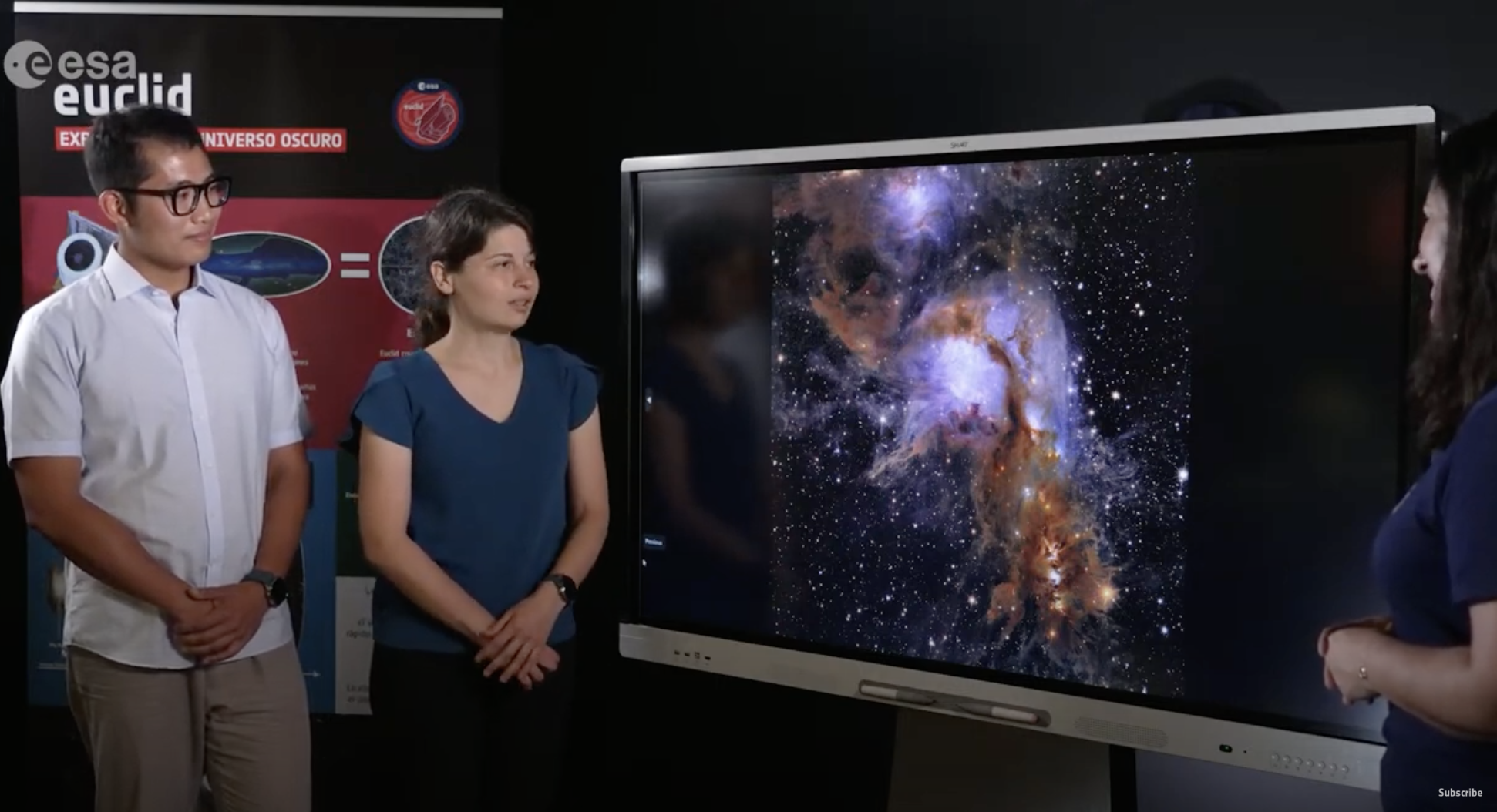
Two members of SUBSTELLAR team participated in the realeasing of the video: Marusa Zerjal (posdoctoral researcher) and Jerry Zhang (predoctoral researcher). 

Their talk start around 7:20 minutes in, and is about the Messier 78 nebula.  

Marusa & Jerry talking about Messier 78

See the whole video at  EUCLID: Celebrating First Science & New Images .


Apr 24 2024, 11:19

SUBSTELLAR project article highlighted in Nature Astronomy journal

The article "Reconnaissance ultracool spectra in the Euclid Deep Fields"   -recently published in  arXiv by SUBSTELLAR researchers and colaborators J.-Y. Zhang, N. Lodieu, and E. L. Martín- has been highlighted in the journal Nature Astronomy . 

According to Lucca Maltagliati, author of the highlight, Zhang et al. demonstrate that Euclid, despite its low spectral resolution, is able to determine the spectral type of observed Ultra Cool Dwarfs (UCD) and determine their age group. The set of eight objects used by the authors can function as a benchmark for future observations. Euclid is expected to visit each Euclid Deep Field around 40–50 times, improving the signal-to-noise ratio substantially and reaching magnitudes of approximately 26.3, 26.5 and 26.4 in the YE, JE, and HE bands, respectively. This will allow it not only to expand our UCD catalogue greatly, but also determine their characteristics such as their parallax, proper motion and photometric variability.

Nature Astronomy publishes research, reviews and commentary at the cutting edge of astronomy, astrophysics and planetary science. Aiming to promote closer interaction between diverse astronomy-relevant disciplines, the editors of the journal consult widely with researchers at all stages of their careers, and more than one third of their commissioned authors are women.

More details at: Maltagliati, L. Expanding our limits with Euclid. Nat Astron 8, 406 (2024).