Presentation

Substellar Science with the Euclid Space Mission (SUBSTELLAR) is a project aimed at mining the Euclid surveys for pushing the frontier of knowledge in substellar science.

SUBSTELLAR is an Advanced Grant awarded to Prof. Eduardo L. Martín (Instituto de Astrofísica de Canarias) by the European Research Council. 

The primary science goal of SUBSTELLAR is to reveal and investigate the faint objects that lurk in the darkness beyond the limits of stellar engines, using mainly the new data arriving from the ESA Euclid space mission.

Euclid is a space mission led by the European Space Agency (ESA) to conduct a deep, single-epoch survey of 15,000 deg2 of sky with visible and near-infrared photometry and spectroscopy, and 40 deg2 multi-epoch very deep surveys. Euclid was launched at July 1st 2023.

The unprecedented combination of sensitivity, areal coverage, spatial resolution, data homogeneity and spectral information will naturally be of tremendous benefit to other areas of astrophysics. Two Euclid Independent Legacy Science (ILS) programs have been designated by ESA to develop and pursue independent science programs that capitalize on the unique data products of the Euclid surveys. SUBSTELLAR will re-use existing ground-based and space-based multiwavelength data to complement the new data obtained with the Euclid space mission.  


LATEST NEWS
Feb 19 2024, 10:29

Post-doc position related to «The stellar-substellar limit in the large scale survey Euclid»

Post-doctoral researcher position in astrophysics at Institut UTINAM, Besançon, France.

The astrophysical team at the Institut UTINAM (Besançon Observatory) is offering a post-doc position related to «The stellar-substellar limit in the large scale survey Euclid.»

The position is funded by the Université of Franche-Comté, for 12 months, renewable.

The successful applicant will work on the identification of ultra cool dwarfs in Euclid fields, and may propose new identification techniques and explore the possibility of using the precise PSF of Euclid to identify close binaries. Other challenges can be addressed, such as to determine the luminosity function, infer the most likely low-mass end of the initial mass function and explore its degree of universality in different components of the Milky Way. 

The candidate will be working with the international Euclid UCD group within the consortium, as well as the Gaia UCD team.

More details can be found at  https://euraxess.ec.europa.eu/jobs/190075


Dec 14 2023, 09:38

Three Postdoctoral Contracts SUBSTELLAR 2023 (PS-2023-091)

The  Instituto de Astrofísica de Canarias  (Tenerife, Canary Islands) invites applications for three postdoctoral contracts to work on the project linked to the line of research “Substellar Science with EUCLID”. 

These contracts are funded by the project “Substellar Science with the Euclid Space Mission (Horizon Europe-ERC-2021-ADG, Gran Agreement 101054354), within the framework of the ERC Advanced 2021 Grant call of the European Research Council Executive Agency within the Horizon Europe financing program of the European Commission, and led by Prof. Eduardo L. Martín.

The appointed candidates will benefit from the research environment at the IAC, which hosts one of the pioneering groups in substellar science around the world. The group is involved in several instrumentation programs, telescope developments, and large area surveys, particularly those carried out with the Euclid space mission.

Deadline: 31/01/2024

More details at SUBSTELLAR postdoctoral contracts


Nov 28 2023, 12:13

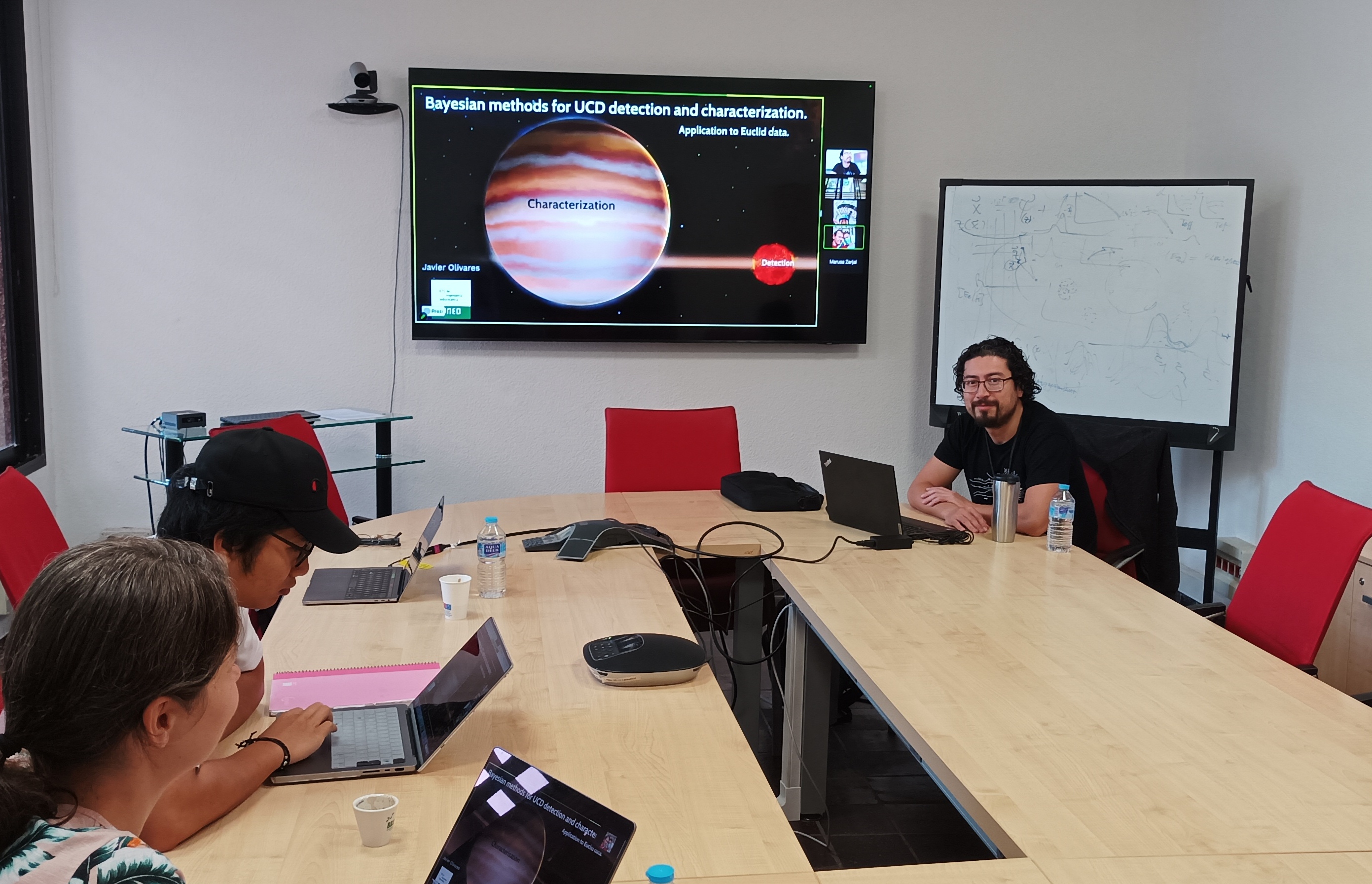
SUBSTELLAR Pizza Seminar held at the IAC (28/11/2023)

The first SUBSTELLAR Pizza Seminar was held today at the IAC by Dr Javier Olivares (UNED). His presentation was focused on Bayesian methods for UCD detection and characterization. An application to Euclid data.

In this presentation, there were overviewed three Bayesian methods for the characterization and detection of UCDs. Kalkayotl and Sakam are twocodes that work with astrometry and photometry, respectively. These two methods can be used to infer the properties of the stellar system to which a UCD belongs. Once the properties of the group have been established, these can be used to infer with better precision the age, mass, position and velocity of the UCD. In the context of Euclid, where only infrared photometry and sky positions will be available, the Bayesian methods can be used to transfer knowledge from the bright and well-characterized stellar members to UCDs with large uncertainties and possibly missing values. The third method, Miec, is a Bayesian hierarchical model created to identify members of stellar clusters with differential extinction. Possible modifications to this code are suggested to fit the Euclid data requirements. Finally, it was also discussed some AI methods that could be of use for UCD detection in the Euclid context.

Dr Olivares  is an astrophysicist whose research focuses on the analysis of stellar systems in the solar vicinity (star-forming regions, stellar associations, and open clusters) particularly on the characterisation of the brown dwarf and planetary-mass domain of the initial mass function.

He did a joint PhD in astrophysics and artificial intelligence (AI) and has spent the last six years as a postdoc researcher. First, contracted by the ERC-founded COSMIC-DANCe project he developed tools that mine catalogues of millions of sources and identify members of stellar systems down to the planetary mass regime. Then, as a postdoc at the IAC (Instituto de Astrofísica de Canarias) his task was to mine the billion-source Gaia catalogue to identify and characterize members in nearby stellar systems and fine-tune the search to ejected low-mass stars and brown dwarfs located in the tidal tails of these systems.  

Currently, Dr Olivares is a postdoc at the Artificial Intelligence Department of the National Distance Education University of Spain (UNED), where he won a grant to exploit current AI developments and apply them to the Astrophysics and Earth science domains. During his first year as a postdoc, he and his students joined two AI paradigms (artificial neural networks and Bayesian hierarchical models) in an age inference method that successfully combines isochrones and Lithium depletion  dating techniques.

See the presentation here  Bayesian methods for UCD detection and characterization. An application to Euclid Data