Presentation

Substellar Science with the Euclid Space Mission (SUBSTELLAR) is a project aimed at mining the Euclid surveys for pushing the frontier of knowledge in substellar science.

SUBSTELLAR is an Advanced Grant awarded to Prof. Eduardo L. Martín (Instituto de Astrofísica de Canarias) by the European Research Council. 

The primary science goal of SUBSTELLAR is to reveal and investigate the faint objects that lurk in the darkness beyond the limits of stellar engines, using mainly the new data arriving from the ESA Euclid space mission.

Euclid is a space mission led by the European Space Agency (ESA) to conduct a deep, single-epoch survey of 15,000 deg2 of sky with visible and near-infrared photometry and spectroscopy, and 40 deg2 multi-epoch very deep surveys. Euclid was launched at July 1st 2023.

The unprecedented combination of sensitivity, areal coverage, spatial resolution, data homogeneity and spectral information will naturally be of tremendous benefit to other areas of astrophysics. Two Euclid Independent Legacy Science (ILS) programs have been designated by ESA to develop and pursue independent science programs that capitalize on the unique data products of the Euclid surveys. SUBSTELLAR will re-use existing ground-based and space-based multiwavelength data to complement the new data obtained with the Euclid space mission.  


LATEST NEWS
Dec 05 2025, 19:05

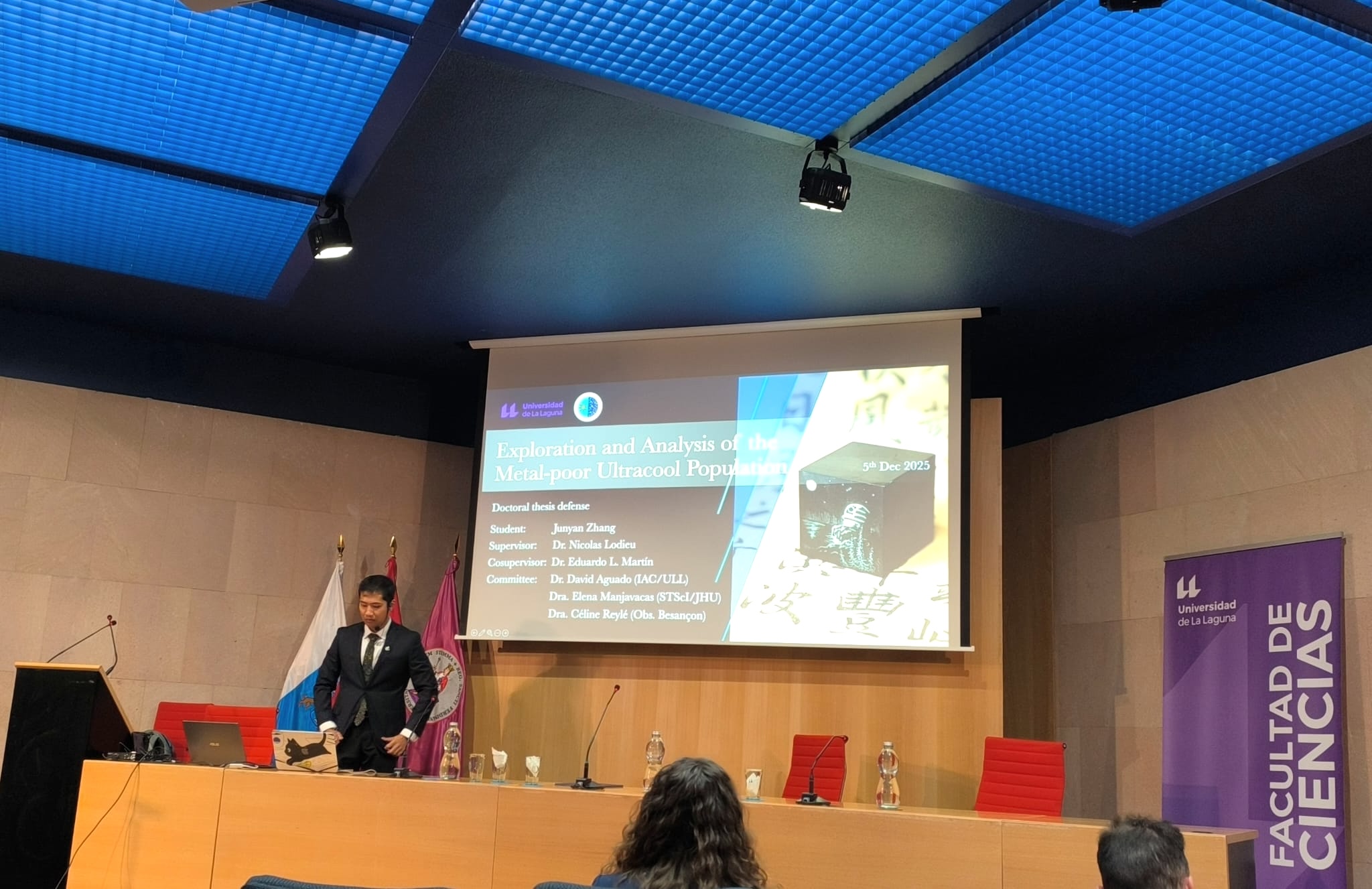
SUBSTELLAR Project First Doctoral Thesis Successfully Defended

Jerry Doctoral Defense1

Jun-Yan Zhang (also known as Jerry) successfully defended the first doctoral thesis related to the SUBSTELLAR Project, receiving unanimous Summa Cum Laude honours from the panel.

The dissertation, which took place at the University of La Laguna, focuses on metal-poor ultracool dwarfs (UCDs). These consist of metal-poor very-low-mass stars, brown dwarfs (BDs) and planetary-mass objects (PMOs), all of which have an effective temperature of less than 2,700 K. These faint, cold objects are like 'galactic fossils' from the early days of the Milky Way. However, their low temperature and luminosity make them extremely difficult to study.

The thesis makes three key contributions:

1. Optical Properties: By observing the coldest metal-poor UCDs (T and Y subdwarfs) in optical light, the research identified a new, unexpected color that serves as a robust indicator of low metallicity. Current atmospheric models cannot explain this, highlighting gaps in our theoretical understanding.

2. Benchmark Analysis: A detailed study of a specific, bright metal-poor dwarf named WISE1810 confirmed it is a T dwarf by detecting methane in its spectrum. The analysis precisely measured its low metallicity and high radial velocity, suggesting it belongs to the Milky Way's thick disk. This demonstrates a method for precisely characterizing similar objects.

3. Companion Search: The research systematically searched for UCD companions orbiting old, metal-poor stars (whose metallicity is well-known). No such companions were found. This null result provides the first statistical upper limit on their frequency (4.0%) and suggests these ancient ultracool dwarfs are universally scarce as wide companions.

In essence, this work advances the detection and characterization of these ancient Galactic fossils, reveals limitations in current models, and provides new methods and constraints for understanding the earliest populations of the Milky Way.

Congratulations to Jerry on taking this important step forward in his already fruitful research career.


Nov 06 2025, 10:25

Prof Eduardo Martín gave a talk to "Amigos del IAC"

Yesterday, Professor Eduardo Martín, the Principal Investigator of the SUBSTELLAR project, gave an informative talk as part of the 'Amigos del IAC' programme.

This programme brings together individuals who support the Instituto de Astrofísica de Canarias in its ongoing efforts to advance our understanding of the universe, promote the high calibre of the Canary Islands Observatories, and foster a culture of science within our society.

The programme organises scientific culture and dissemination activities so that its members can increase their knowledge of the Instituto de Astrofísica de Canarias and its work.

These activities cover all the fundamental areas in which the institute is involved, primarily the dissemination of astrophysical information and the promotion of the Canary Islands Observatories.

Professor Martín, a renowned researcher in the field of substellar science, gave a talk entitled ¿Qué hay entre las estrellas y los planetas?  (in Spanish), which translates as 'What lies between stars and planets?'

He talked about this fascinating area of astrophysics and provided an insight into the work being conducted by his team and himself within the framework of the project Substellar Science with the Euclid Space Mission (SUBSTELLAR), for which he received an Advanced Grant from the European Research Council.


Sep 03 2025, 18:41

Subtellarers attended BD30

SUBSTELLAR predoctoral students Sara Muñoz, Jun-Yan Zhang (Jerry), Styliani Tsilia and Nafise Sedighi attended the conference "BROWN DWARFS KEEP THEIR COOL: 30 YEARS OF SUBSTELLAR SCIENCE" (BD30). The conference took place at the hotel Jardin Tecina , located on the island of  La Gomera in the  Canary Islands  (Spain).

The BD30 conference celebrated the 30th anniversary of the discovery of the first Brown Dwarfs and reviewed the most recent substellar studies with special emphasis on metal-poor objects.

The conference also included a tribute to our colleague and friend Prof Yakiv Pavlenko, who passed away at the end of 2024.

Representatives from the SUBSTELLAR project formed part of the Scientific and Local Organising Committees.

The SUBSTELLAR project PI, posdocs and predoctoral students presented the current status of their research works at the Conference.

More details at meeting Website  Brown Dwarfs Keep Their Cool: 30 years of Substellar Science .