
CELESTE – Cutting Edge Leap to Excellence in Space and Optics Technologies
CELESTE is an ambitious initiative led by the Instituto de Astrofísica de Canarias (IAC) that seeks to consolidate the Canary Islands as an international benchmark for advanced research and technological innovation in two closely connected fields: Advanced Optical Systems and New Space.
The project is designed to establish a long-term, self-sustaining Centre of Excellence (CoE) within IACTEC, the IAC unit focused on technological development and cooperation with industry. Through this framework, CELESTE strengthens regional capabilities in high-impact scientific knowledge generation, advanced technology development, and sustainable innovation ecosystems.
A strategic European project
Launched on 1 January 2025, CELESTE will be implemented until the end of 2030. The project is supported by European funding and reinforced through regional and insular public investment, and it has been officially recognised as a strategic initiative in the domains of Astrophysics, Space and Aeronautics.
CELESTE is strongly aligned with the Smart Specialisation Strategy for the Canary Islands (2021–2027), which promotes international leadership in Astrophysics and Space Sciences while underlining the significant socio-economic benefits derived from scientific and technological activity in the region.
International collaboration and excellence
International cooperation is a central pillar of CELESTE. The project works in close partnership with leading organisations such as the European Space Agency (ESA) and the Centre National de la Recherche Scientifique (CNRS), gaining access to high-level expertise in key areas including:
- Design and development of advanced astronomical instrumentation
- Quantum and optical communication technologies for secure space-to-Earth data transmission
- Manufacturing of ultra-high-precision optical components
- Strategic and managerial expertise supporting sustainable research and innovation structures
These collaborations foster the exchange of knowledge, promote researcher mobility, and reinforce long-term scientific cooperation at both European and global levels.
Objectives and scope
CELESTE is structured around the creation of a solid foundation for the long-term autonomy of a Centre of Excellence by pursuing the following objectives:
- Establishing stable partnerships with international institutions and ensuring long-term financial viability
- Promoting advanced training programmes, mobility schemes, and knowledge exchange to attract and retain highly qualified talent
- Deploying and operating a new generation of high-tech laboratories dedicated to space and optical technologies
- Developing a strong ecosystem that connects scientific research, technological development, industry, and society
The project addresses both scientific research and technological innovation, with a clear focus on capacity building, knowledge transfer, and future industrial and commercial exploitation.
CELESTE laboratories
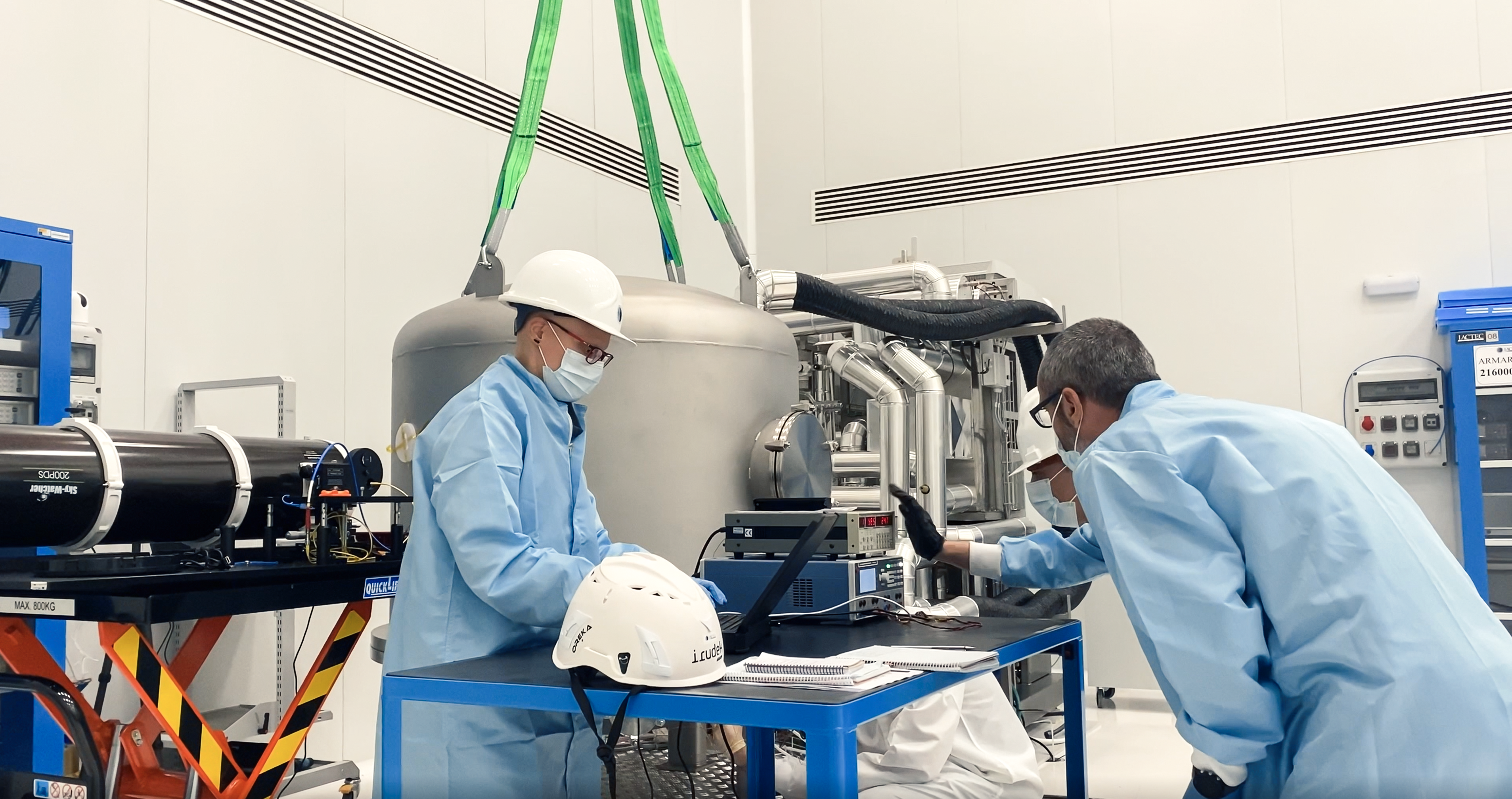
CELESTE’s scientific and technological activities are supported by a coordinated network of specialised laboratories hosted at IACTEC. These facilities form the backbone of the project, offering complementary expertise across optics, photonics, opto-mechanics, adaptive optics, satellite payload development, and quantum communications.
- Quantum & Optical Communications Lab
- SPACE-Lab
- LIOM (Laboratory for Innovation in Opto-Mechanics)
- Adaptive Optics Lab
- Advanced Optical Systems Lab
From research to impact
By enhancing the technological capabilities of IACTEC and expanding its laboratory infrastructure, CELESTE supports the development of next-generation optical systems, space instrumentation, and quantum technologies.
CELESTE officially started on 1st January 2025 and will run until the end of 2030. It is funded by the European Union under Grant Agreement nº 101136736 with complementary funding by the Canary Islands regional government (Gobierno de Canarias) and insular public investment (Cabildo de Tenerife).
Funded by the European Union. Views and opinions expressed are however those of the author(s) only and do not necessarily reflect those of the European Union or the Research Executive Agency. Neither the European Union nor the granting authority can be held responsible for them.