Quantum & Optical Communications Lab
From the Canary Islands, the Quantum & Optical Communications Lab explores one of today’s most exciting frontiers: optical and quantum communications. The laboratory develops advanced laser-based systems capable of transmitting data at very high speeds between Earth and space, combining free-space optical communications (FSOC), quantum key distribution (QKD), adaptive optics, integrated photonics, and advanced detection technologies.
Our research bridges fundamental science and real-world applications, contributing to the development of fast, secure, and resilient communication technologies for terrestrial, airborne, and space-based platforms.
IAClink: A Unique Real-Environment Testbed
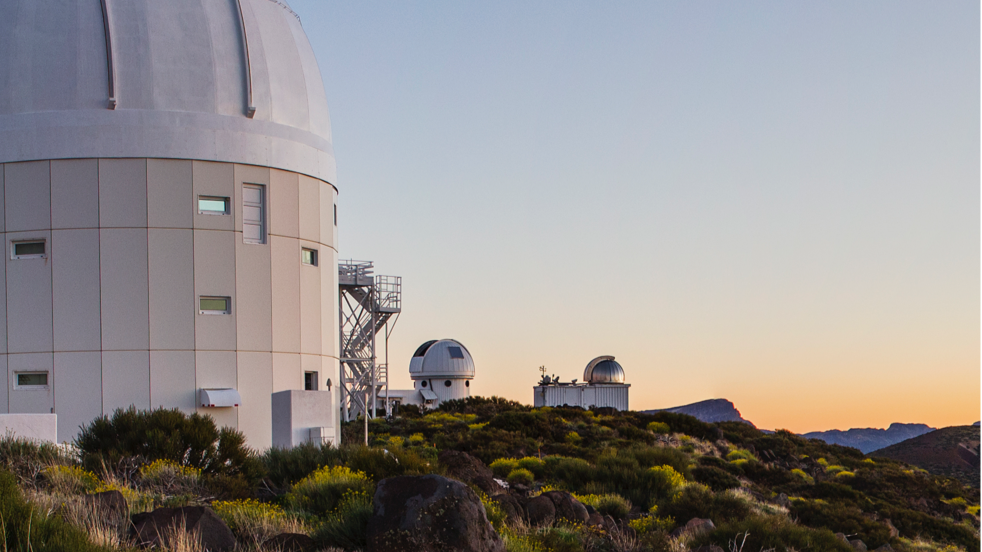
A key asset of the laboratory is IAClink, a unique European optical communications testbed connecting the Optical Ground Station at Teide Observatory (Tenerife) with the Jacob Kapteyn Telescope at Roque de los Muchachos Observatory (La Palma), spanning 144 kilometers.

This real inter-island free-space optical link enables:
- Validation of optical and quantum communication terminals
- Testing of QKD systems under realistic atmospheric conditions
- Optimization of control and pointing algorithms
- Performance assessment of adaptive optics correction in long-distance links
IAClink provides an exceptional environment to mature technologies from laboratory prototypes to operational systems.
Research & Innovation Areas
The Quantum & Optical Communications Lab focuses on the following key innovation areas:
- Free-space optical communications, both classical and quantum
- Quantum Key Distribution (QKD) for secure communications
- Adaptive optics applied to FSOC and QKD systems
- Integrated photonics for compact, robust, and scalable terminals
- Real-environment validation through long-distance atmospheric links
- Optical ground-to-space and space-to-ground communications
Space Missions & Flagship Projects
Optical Communications Payloads
A space-to-ground optical communications module based on CCSDS standards has been integrated as a payload aboard the ALISIO-1 satellite, enabling high-speed optical downlinks and in-orbit characterization of atmospheric turbulence effects and adaptive optics correction.
Quantum Communications Missions
The group participates in European consortia developing QKD systems for terrestrial, LEO, and GEO scenarios, including hosted payloads for quantum communications from geostationary orbit. Contributions include:
- Design of adaptive optics systems for ground stations
- Link budget analysis and performance optimization
- Support to telescope and terminal design
Advanced Concepts & Future Exploration
The laboratory has contributed to international initiatives exploring extreme optical communication scenarios, including simulations of deep-space optical links using distributed telescope arrays.
Transportable Optical Communication Stations
One of the laboratory’s strategic developments is a transportable free-space optical communication station, conceived as a mobile laboratory. This platform is designed to operate in multiple scenarios:
- Inter-island and inter-urban links
- Ground-to-LEO and ground-to-GEO satellite links
- Ship-to-shore and air-to-ground communications
The system enables rapid deployment, experimental validation, and continuous improvement of adaptive optics techniques in real operational environments.
Collaboration & Technology Transfer
The Quantum & Optical Communications Lab is open to collaboration with industrial partners, research institutions, and space agencies and system integrators.
The laboratory offers facilities and expertise for:
- Component and subsystem testing
- Payload integration and validation
- Joint development of commercial and pre-commercial solutions
Our mission is to bring free-space optical and quantum communication technologies closer to the market, positioning the Canary Islands as a reference hub for secure, high-speed, and sustainable communications.
Leadership
Principal Investigator: Luis Fernando Rodríguez