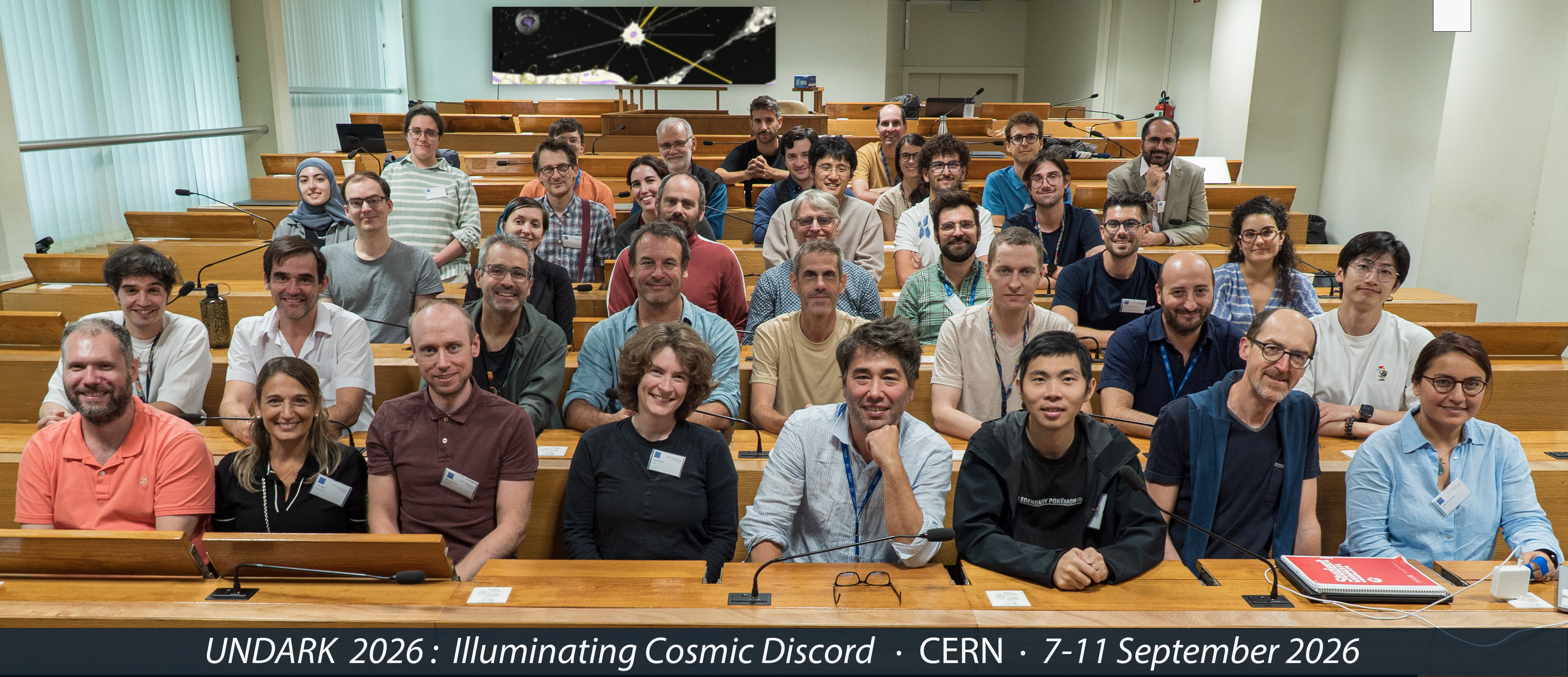
2nd UNDARK CERN-TH Institute: Illuminating Cosmic Discord (September 7-11, 2026)
Modern cosmology is at a crossroads. The standard LCDM model, while incredibly successful, faces a series of persistent challenges and "tensions" between key datasets. The most prominent one is on today’s expansion rate (H_0 tension) but others have emerged on the late redshift expansion potentially calling for a time dependent dark energy. These tensions may suggest either new physics or unresolved systematic errors. This places us at a crossroads, where the lack of a robust concordance model challenges our ability to interpret precision cosmology, key to address some open questions in particle physics.
Simultaneously, we are in an era of unprecedented data flow. Initial results from DESI, mature analyses from ACT and KiDS, and paradigm-challenging discoveries from JWST (such as the "Little Red Dots") provide a complex, and potentially contradictory, picture of the cosmos.
This workshop is motivated by the urgent need to move beyond single-tension discussions. We must synthesize these new, multi-probe datasets and theoretical ideas into a consistent global picture. The workshop will bring together experts in theory, observation, and computation to evaluate where concordance remains robust, where it breaks down, and how the next generation of surveys and theoretical tools can close the gap.
More info at the website: https://indico.cern.ch/event/1616316/
1st UNDARK CERN-TH Institute: Making Neutron Stars a Laboratory for New Physics (June 9-13, 2025)
This one-week TH-Institute (June 9-13, 2025) aims to bring together leading experts in nuclear physics, astrophysics, and particle physics to address the key questions surrounding the equation of state (EOS) of neutron star (NS) matter and its impact on multi messenger astronomy and new physics searches.
The EOS of neutron stars is crucial to understanding several astrophysical phenomena, from supernova explosions and neutrino emissions to gravitational wave signals from NS mergers. By examining the EOS and its interplay with standard model (SM) and beyond-standard model (BSM) physics, this event seeks to address questions like: What are the uncertainties in EOS modeling, and how can they be minimized to yield robust predictions? How do different EOSs affect GW signals and NS cooling mechanisms? How much different EOS impact constraints on new motivated particles, such as the QCD axion? What role does QCD EOS play in the formation of primordial black holes, and how can observations of NS mergers constrain new physics?
The TH-Institute will thus cover a range of topics, including:
- Theoretical modeling of the EOS of NS matter and its observational implications
- Neutrino emissions from young and old neutron stars, and their role in SN explosions
- Gravitational wave signals from NS mergers and their sensitivity to the EOS
- New physics searches in astrophysical environments, with a focus on axions, neutrinos, and gravitational waves
More info can be found in the website: https://indico.cern.ch/event/1509219/