Outreach Talks in Spanish
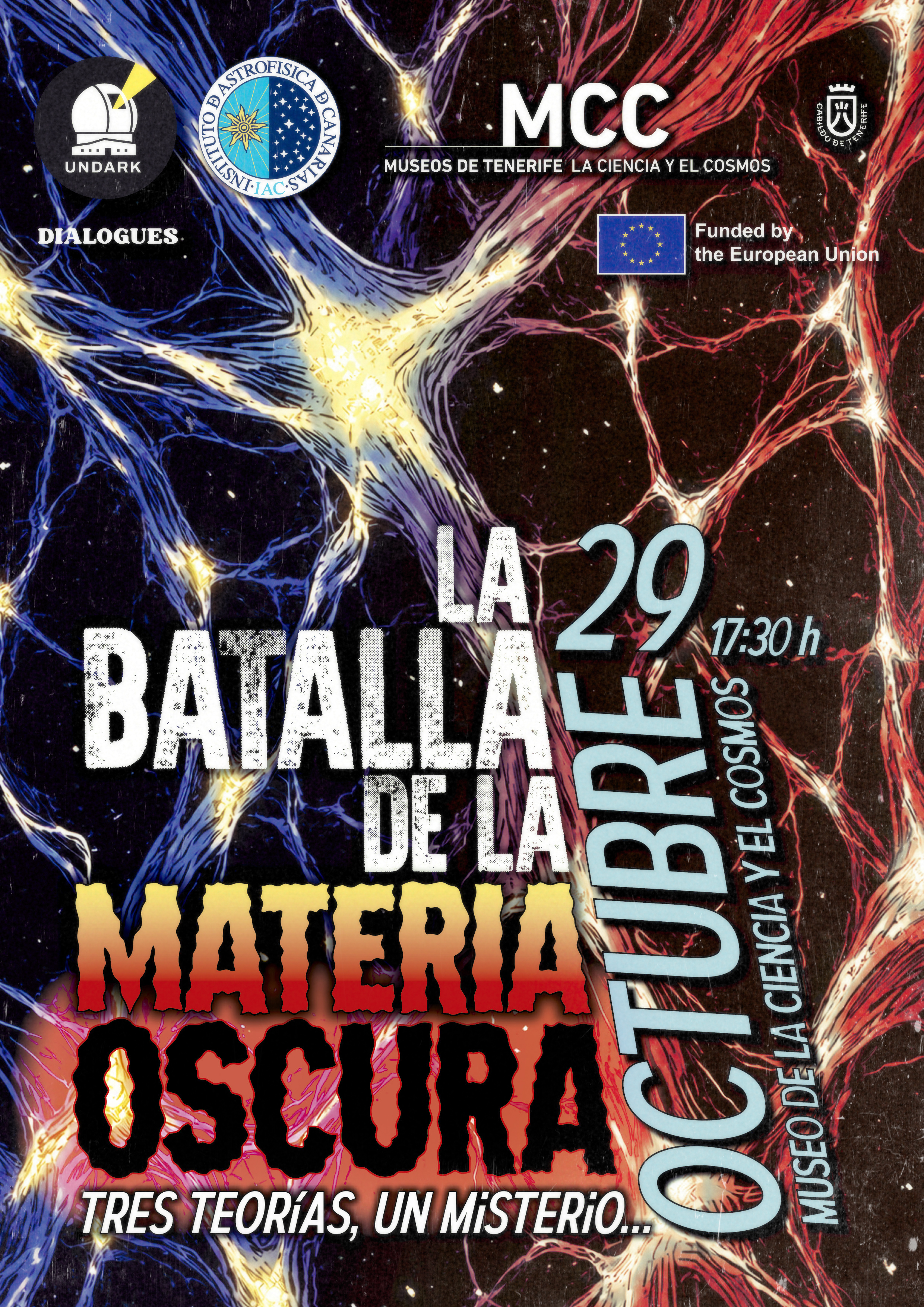
La batalla de la Materia Oscura - María Benito Castaño (IAC), Isabel Santos Santos (AIP, Alemania), Jorge Sánchez Almeida (IAC) & Guillaume Thomas (ULL)
October 29, 2026
Speakers:
- María Benito Castaño (IAC): Introduction to dark matter and the evidence for its existence.
- Isabel Santos Santos (AIP, Germany): Defense of cold dark matter.
- Jorge Sánchez Almeida (IAC): Presentation of alternative models of dark matter.
- Guillaume Thomas (ULL): Defense of the modified gravity perspective.
Summary: There’s something out there that we can’t see, but whose gravity leaves mysterious traces in the Universe… Sounds like a Halloween story, doesn’t it? Well, it’s one of science’s greatest mysteries: dark matter. What is it made of? What if, to solve this mystery, we had to change the way we understand gravity? In “The Battle of Dark Matter. Three Theories, One Mystery,” four researchers will help us follow the clues of the invisible, and three scientific proposals will face off in a battle of arguments. You’ll have a role to play, too: you can use your cell phone to take part in a quiz with prizes from the IAC and vote for the explanation that convinces you the most. Come to the Museum of Science and the Cosmos on October 29 at 5:30 p.m.: this Halloween, the mystery has cosmic dimensions.
Biographies:
María Benito Castaño. Postdoctoral researcher at the Canary Islands Institute of Astrophysics. Her work bridges astrophysics and particle physics to investigate the nature of dark matter through its traces in our galaxy.
Isabel Santos Santos. Researcher at the Leibniz Institute for Astrophysics in Potsdam, Germany. She holds a Ph.D. from the Autonomous University of Madrid and has worked in Canada and the United Kingdom. She studies dwarf galaxies using cosmological simulations to understand dark matter.
Jorge Sánchez Almeida. Research professor at the Canary Islands Institute of Astrophysics and Ph.D. from the University of La Laguna. After researching the Sun and the evolution of galaxies, he is currently seeking to elucidate the nature of dark matter through astrophysical evidence.
Guillaume Thomas. Ramón y Cajal Research Fellow at the University of La Laguna; he earned his Ph.D. at the Strasbourg Observatory. A specialist in galactic archaeology and dynamics, he combines observations and simulations to study the Milky Way and test various models of gravity.
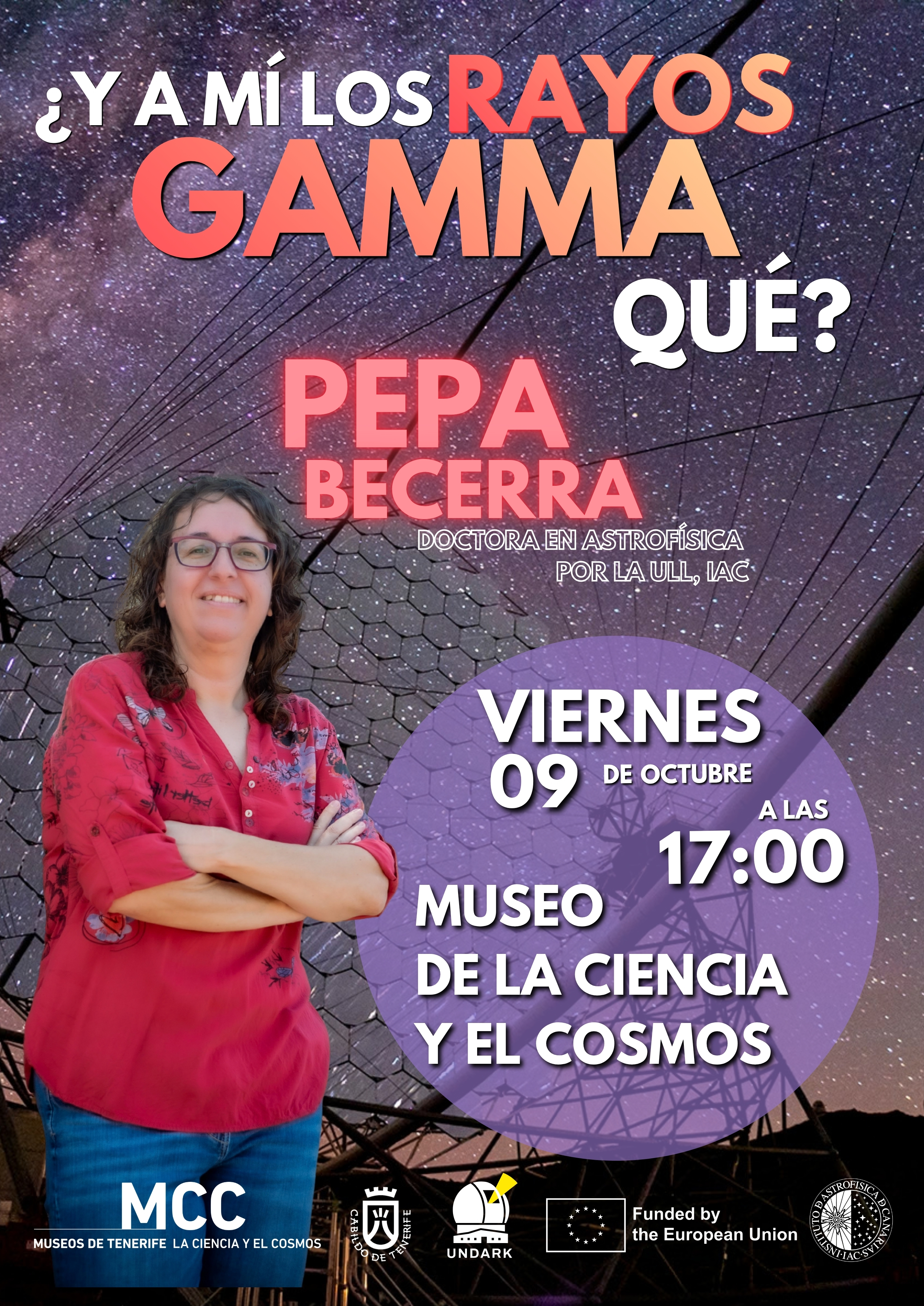
¿Y a mí los Rayos Gamma qué? - Pepa Becerra (IAC, Spain)
October 9, 2026
Speaker: Josefa Becerra González, Postdoctoral Researcher (ULL, IAC)
Title: “So What Do Gamma Rays Have to Do with Me?”
Date: Friday, October 9, at 5:00 p.m. Museo de la Ciencia y el Cosmos.
Abstract: The most extreme electromagnetic radiation in the universe, the highest-energy processes we know of, phenomena like the death of stars or the dynamics around black holes… All of this sounds fascinating, but what does it have to do with me? “Cut the crap—I’ve got enough on my plate as it is…” But wait a minute… What if I told you that the battery in the cell phone or laptop you’re probably reading this on is involved in all this commotion? What if that distant, energetic universe were passing right through you right now? What do you say to that? Come to the Museum of Science and the Cosmos on October 9 at 5:00 p.m., and let’s discover together what gamma rays have to do with you.
Biography: Born in Málaga and with close ties to the Canary Islands, Pepa Becerra began her studies in physics at the University of Granada before moving to Tenerife to specialize in astrophysics. After completing her Ph.D. in the Canary Islands, she pursued her research career in Germany, Switzerland, and the United States, where she worked on one of NASA’s satellites at the Goddard Space Flight Center. Currently back in Tenerife, she is working on the development of gamma-ray astronomy using Cherenkov telescopes, a field in which the Canary Islands play a leading role, with facilities at the Roque de los Muchachos Observatory on La Palma and the Teide Observatory on Tenerife.
Context of the talk: 2nd UNDARK Workshop https://meetings.iac.es/astrodarkgamma/pages/committees.php
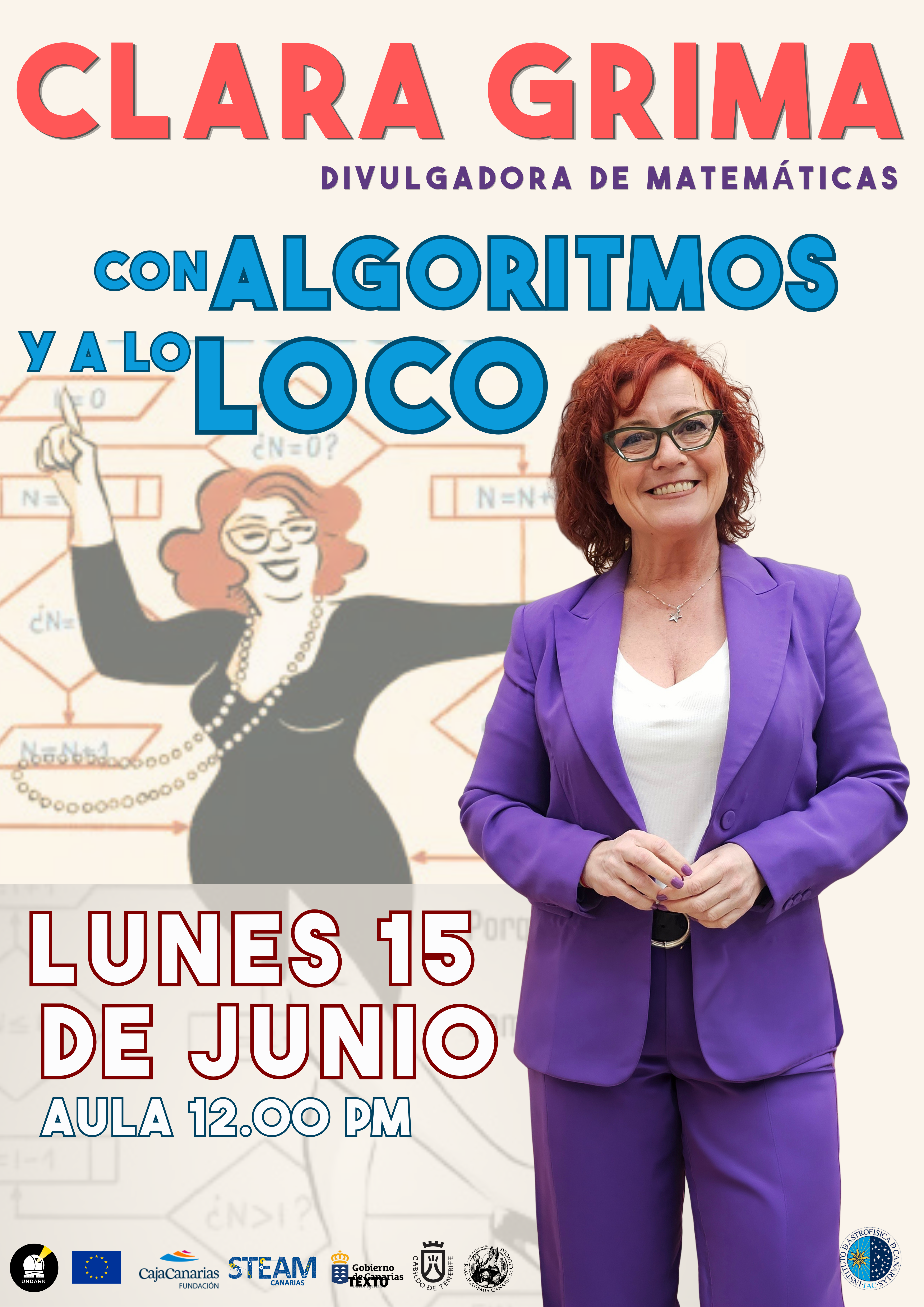
Con algoritmos y a lo loco - Clara Grima (University of Granada, Spain)
June 15, 2026
Clara Grima, mathematics lecturer and one of Spain’s best-known science communicator, comes to the IAC to tell us about her book "Con algoritmos y a lo loco". This talk is held in the framework of Premio Cosmos 2026.
Did you know that algorithms are behind many of the decisions we make every day? From the routes we follow on our mobiles to the recommendations we receive on social media or digital platforms, algorithms are a much bigger part of our lives than we realise. In her book "Con algoritmos y a lo loco", Clara Grima also demonstrates that algorithms did not originate with computers: we have been using them for centuries to solve problems, organise tasks and make decisions, often without even realising it. With her characteristic humour, approachability and passion for science communication, Clara will introduce us to the fascinating world of mathematics in an engaging, entertaining way, full of surprising examples.
El fondo cósmico de microondas: desvelando el origen del Universo - Jose Alberto Rubiño (IAC, Spain)
September 30, 2025
This lecture, titled "The Cosmic Microwave Background: Unveiling the Origin of the Universe," is presented by Dr. José Alberto Rubiño, Research Professor at the IAC and a leading cosmologist. The talk was held on the occasion of UNDARK's First Workshop: Astrophysical Probes of Dark Sectors with Radiowave Observations , 29th September to 3rd October, 2025, La Laguna, Tenerife.
The talk established the Cosmic Microwave Background (CMB) as the crucial "fossil proof" of the universe's hot past, serving as a fundamental pillar for modern cosmological understanding. Dr. Rubiño guided the audience through the vast scales of the Observable Universe, discussing how we leverage tools like General Relativity and radio astronomy to study the universe's origin, evolution, and fundamental composition. The presentation underscored the surprising necessity of quantum mechanics to fully comprehend the universe's beginning and highlighted cutting-edge research, including the Quijote and Tenerife Microwave Spectrometer experiments, that seeks to extract more information from this faint relic of the Big Bang.