

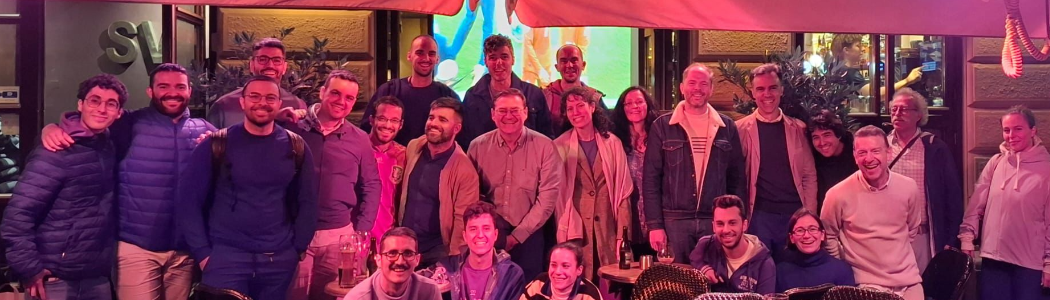
The project presented in Copenhagen results related to the development of new technologies for the direct detection of exoplanets, high-precision space photometry, and Earth observation from small satellites.
The CELESTE project took part in SPIE Astronomical Telescopes + Instrumentation 2026, one of the leading international conferences dedicated to the development of telescopes, astronomical instrumentation, and related technologies. The conference, held from 5 to 10 July in Copenhagen, Denmark, brought together specialists from research centres, observatories, universities, space agencies, and technology companies from around the world.
CELESTE's participation highlighted the work being carried out from the Canary Islands in two strategic lines of the project: on the one hand, research into advanced optics, optomechanics, and photonics for future direct exoplanet detection systems; and, on the other, the development of space instrumentation for small satellites, aimed at both astrophysics and Earth observation.
In the field of advanced optics, the LIOM team presented three contributions focused on the development of technologies for the Small Exo-Life Finder (SELF), a hybrid interferometric telescope conceived as a technology demonstrator for the future Exo-Life Finder (ELF). These papers addressed different strategies for tackling one of the major challenges of distributed-aperture telescopes: keeping multiple independent mirrors aligned and co-phased with the precision required to move towards the direct imaging of exoplanets.
Natalia Arteaga Marrero presented the work "Machine learning-driven autonomous control of the distributed aperture for the Small Exo-Life Finder (SELF) Telescope", focused on the use of machine learning to align the SELF mirrors using only focal-plane images. The study showed that it is possible to estimate the position of the mirrors from images obtained with nanoELF, a real laboratory prototype, smaller and simpler than SELF, which experimentally reproduces a distributed-aperture architecture. The results demonstrate the potential of machine learning as a tool for the autonomous control of complex optical systems.
For her part, Adrián Sánchez Chaves presented the contribution "Using a photonic lantern aided by machine learning as wavefront sensor for cophasing a distributed aperture", on the use of a photonic lantern, a device based on optical fibres, combined with machine learning to align optical systems made up of mirrors separated from one another, as is the case in SELF. The study explored how the intensities collected in the different cores of the photonic lantern can be used to estimate piston, tip, and tilt errors in the mirrors, with the aim of advancing towards the co-phasing of distributed apertures.
The third LIOM contribution was presented by María Auxiliadora Padrón Brito, with the work "A focal-plane wavefront sensor based on a short multimode fiber and machine learning". This study showed the first open-loop experimental demonstration of a wavefront sensor developed at LIOM, based on a short multimode fibre, approximately one centimetre long, and on machine learning techniques. The sensor, for which the IAC has filed a patent application, is placed at the telescope's focal plane, which reduces some of the limitations of traditional sensors. It is also a simple, low-cost solution that is easy to stabilise mechanically and in temperature.
These three contributions reflect LIOM's role within CELESTE as a laboratory focused on the development of very high-precision optical and photonic technologies. LIOM members Natalia Arteaga Marrero, María Auxiliadora Padrón Brito, and Adrián Sánchez Chaves took part in the conference, sharing their own results related to the use of machine learning, wavefront sensors, and photonic solutions for future direct exoplanet imaging systems.
The IAC's Space lab also had a notable presence at SPIE with three papers related to the development of instrumentation for small satellites. The first, "DRAGO Project: SWIR cameras for nano- and micro-satellites", was presented by Juan Francisco Hernández Cabrera and covered the evolution of the DRAGO family of infrared cameras, developed within the framework of IACTEC-Space for Earth observation and astrophysical applications from small-scale platforms.
The work reviewed the results obtained with DRAGO-1 and DRAGO-2, instruments that operate in the SWIR range and have demonstrated their usefulness in observing natural phenomena from space, such as the 2021 La Palma volcanic eruption and the 2023 Tenerife wildfire. The contribution also described the features of DRAGO-3, the new generation of the series, which will incorporate four NIR/SWIR bands and a resolution of approximately 9 metres per pixel, with the aim of strengthening natural disaster monitoring as part of the future Canary Islands Earth observation constellation.
The second paper from the Space lab was "IACSAT-DUNE: preliminary pointing jitter characterization and its impact on exoplanet photometry", by David Rodríguez Muñoz. This work focused on the preliminary characterisation of pointing jitter and its impact on exoplanet photometry for IACSAT-DUNE, the IAC's future space-observatory satellite. The mission is designed to carry out high-precision photometry in the VIS-NIR-SWIR range, between 450 and 1700 nanometres, with the main goal of contributing to the confirmation of Earth-like planets located in the habitable zone of red dwarf stars.
Pointing stability is a critical aspect for this type of measurement, since the movement of the image across the detector's pixels can introduce photometric noise. The paper put forward an initial approach to quantifying this source of noise and establishing requirements for IACSAT-DUNE's Pointing and Focus Control System (PFCS), a subsystem designed to improve the satellite's pointing performance.
The third contribution linked to the Space lab was "DRAGO-2 spatial stability in orbit: MTF monitoring with lunar and Suez targets", also by Juan Francisco Hernández Cabrera. The work analysed the in-orbit spatial stability of DRAGO-2, the infrared camera on board ALISIO-1, the first satellite launched by the IAC in December 2023. To this end, images of the lunar limb and the Suez Canal were used as alternative references to estimate the modulation transfer function, given the camera's spatial resolution of approximately 50 metres per pixel.
The results obtained suggest a possible degradation in the camera's spatial performance between October 2025 and June 2026, although the work itself notes that the limited sample size and target-dependent effects still make it impossible to definitively quantify this phenomenon or precisely identify its physical cause. The paper stressed the need for further acquisitions to verify the trend and constrain its evolution.
With these contributions, CELESTE strengthens its presence in the international field of astronomical and space instrumentation, showcasing advances that connect frontier research with applied technological development. Participation in SPIE Astronomical Telescopes + Instrumentation 2026 made it possible to highlight the work carried out at the IAC in key areas for the future of observing the Universe: the direct detection of exoplanets, advanced optics, photonics, high-precision space photometry, and Earth observation from small satellites.
The presence of the LIOM and Space teams at this international forum also helps to strengthen CELESTE's standing as a platform for the development of strategic technologies from the Canary Islands, in collaboration with leading scientific and technological institutions.