Field-level inference of the large-scale structure
Field-level inference of the large-scale structure aims to reconstruct the primordial density field, the evolved matter distribution, and the processes linking matter to observable tracers directly from the data, rather than relying only on summary statistics such as the power spectrum or the correlation function. This approach has gained increasing attention because it seeks to extract nearly all the cosmological information encoded in galaxy surveys within a physically consistent Bayesian framework. In this picture, reconstruction is formulated as a generative problem: one starts from a prior on the initial conditions, evolves them forward with a model of structure formation, connects the matter field to the observed tracers through a bias prescription, and compares the prediction with the data. The task is therefore to sample the posterior distribution of the latent initial field and model parameters conditioned on the observations.
A foundational step in this direction was the introduction of hierarchical Bayesian reconstruction by Kitaura & Enßlin (2008) . This work established Bayesian statistics as the natural framework for large-scale-structure inference, making it possible to combine prior information, observational effects, and the statistical nature of tracer counts in a unified way. A major methodological advance followed with Jasche & Kitaura (2010) , who first applied Hamiltonian Monte Carlo to Bayesian large-scale-structure inference. This was crucial because field-level inference is an extremely high-dimensional problem and therefore requires efficient gradient-based sampling techniques to become computationally feasible.
The next major conceptual step was the transition from inverse methods to forward modelling. Instead of attempting to recover the initial conditions by directly inverting the final galaxy field, one samples initial conditions, evolves them through a model of gravitational dynamics, applies a tracer model, and compares the resulting prediction with the observations. In this framework, Kitaura et al. (2012b) presented the first forward-model reconstruction of the large-scale structure from observational data including peculiar motions. This programme is closely associated with the KIGEN code ( Kitaura 2013 ), which was the first framework to combine Bayesian reconstruction, forward structure formation, and advanced sampling techniques such as Gibbs sampling and Hamiltonian Monte Carlo to infer the cosmic web from redshift surveys. Its conceptual advance was to treat the observed galaxy distribution not as a field to be inverted directly, but as the outcome of a generative process linking primordial fluctuations, gravitational evolution, peculiar velocities, and tracer formation.
An equally important line of progress concerned the treatment of bias at the field level. The earliest Bayesian approaches employed a full Poisson likelihood, as in Kitaura & Enßlin (2008) and Kitaura et al. (2010) . However, the Poisson approximation is too restrictive in many realistic situations, since galaxy and halo counts often show significant deviations from Poissonity. A key advance was therefore the introduction of the negative binomial distribution in the context of field-level bias by Kitaura et al. (2014) , later implemented in Bayesian inference by Ata, Kitaura et al. (2015) together with the power-law plus low-density threshold bias model introduced in the same earlier work. This made it possible to model non-Poisson stochasticity, or over-dispersion, within a hierarchical Bayesian framework and represented an important step toward realistic field-level tracer modelling.
Another crucial aspect of field-level inference is the treatment of peculiar velocities and redshift-space distortions. Broadly speaking, three main Bayesian strategies have been developed. The first is an iterative redshift-to-real-space mapping performed in a Gibbs-sampling fashion, connected to Kitaura & Enßlin (2008) and later developments such as Kitaura et al. (2012c , 2016a ). In this case, real-space reconstruction and redshift-space correction are updated alternately within the Bayesian scheme. The second is forward modelling of redshift-space distortions at the tracer level, first introduced by Kitaura et al. (2012b) . In this method, tracers are evolved from sampled initial conditions into redshift space, and the resulting redshift-space tracer field is compared directly with the observations. For small-scale virial motions, two variants were developed: in the original implementation, elliptical groups of galaxies were collapsed, so that the modelling focused mainly on coherent large-scale flows, while a later extension by Heß, Kitaura et al. (2013) retained the fingers-of-God features and described them through an additional stochastic velocity-dispersion component. The third strategy is forward modelling of redshift-space distortions at the dark-matter-field level, where the matter field itself is mapped into redshift space within the inference loop. Bos, Kitaura & van de Weygaert (2019) presented the first implementation of this idea within a Hamiltonian-Monte-Carlo Bayesian framework, making redshift-space distortions part of the forward model rather than a separate correction stage.
A further important advance was the extension of Bayesian field-level inference to the lightcone, where cosmic evolution is treated explicitly rather than approximated within a single snapshot. This was achieved with the COSMIC BIRTH code in Kitaura et al. (2021) , which brought together lightcone geometry, nonlinear structure formation, and cosmic evolution within the Bayesian reconstruction framework. This step was particularly important for bringing field-level inference closer to the way galaxy surveys are actually observed, since real data trace an evolving Universe along the line of sight rather than a static volume.
The most recent step in this progression is the BRIDGE approach ( Rosselló, Kitaura et al. 2026 ), which combines fast effective structure-formation models with effective field-level bias in a fully differentiable framework. In particular, it implements the kind of nonlinear, nonlocal, and stochastic bias description developed for HOLI-MOCKS, and introduces a fuzzy cosmic-web classification so that transitions between web environments become smooth and differentiable. This is essential for efficient gradient-based sampling. By coupling this idea to GPU-accelerated computations in JAX, BRIDGE enables scalable Bayesian field-level inference with effective gravity solvers, cosmic-web-dependent bias, and differentiable forward modelling.
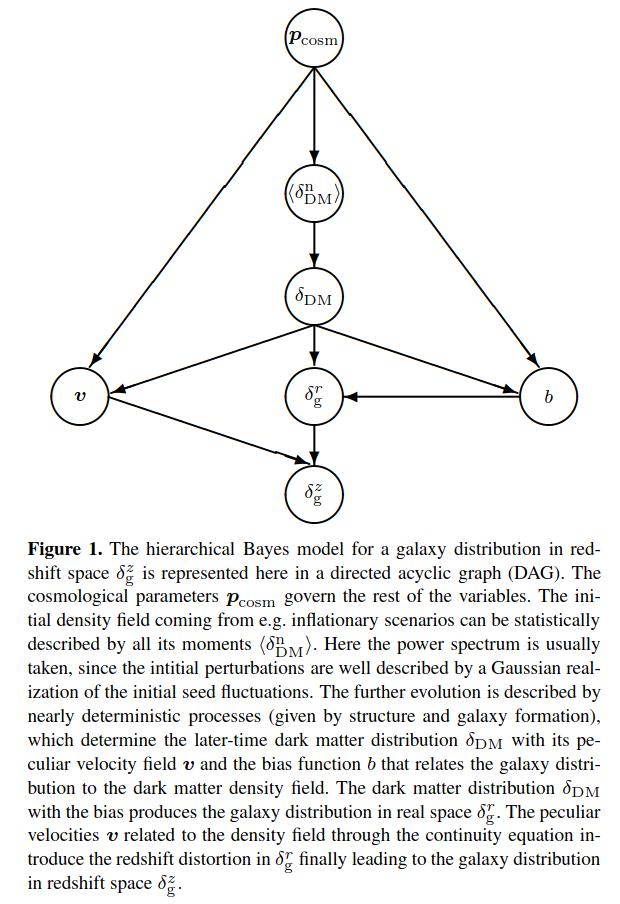
Figure below from Kitaura & Enßlin 2008 (credit Kitaura 2007). This Bayesian hierarchical model is still valid today.
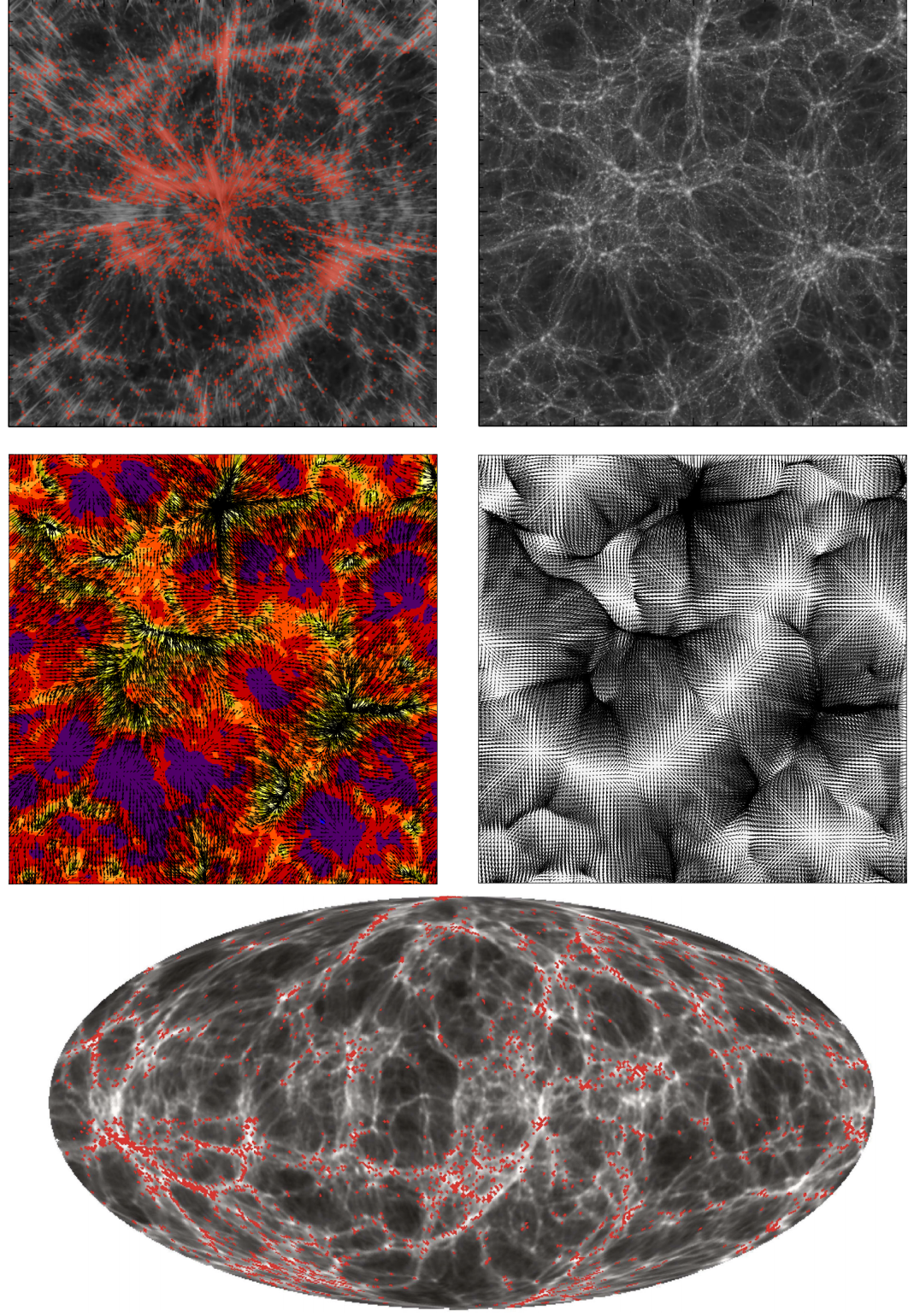
The Figure below: Credit: FSK & Hess. Bayesian field-level reconstructions with forward modeling. The reconstructions and plots were produced by me. The dark matter distribution was computed by Steffen Hess from the initial conditions I obtained with the KIGEN code (Kitaura 2013; Kitaura et al. 2012; Hess, Kitaura & Gottloeber 2013; Nuza, Kitaura et al. 2014; Hess & Kitaura 2016). Top left: galaxies in red with the underlying dark matter in redshift space; right: matter in real space; middle left: velocity fields overlaid on the matter distribution; middle right: velocity fields generating caustics; bottom: distribution of galaxies and dark matter projected onto the sky.