Mock Galaxy Catalogues
Mock galaxy catalogues are essential tools in modern cosmology. They are used to test analysis pipelines, estimate covariance matrices, optimize survey strategies, and interpret clustering measurements in terms of cosmology and galaxy formation. Different kinds of mocks serve different purposes: some aim for maximum physical realism, while others are designed for speed, flexibility, or the efficient production of very large numbers of realizations.
1. Hydrodynamical cosmological simulations
The most detailed mock catalogues come from hydrodynamical cosmological simulations, in which both dark matter and baryons are evolved and astrophysical processes such as gas cooling, star formation, and feedback are included. These simulations are indispensable for understanding galaxy formation in physical detail and for connecting observable galaxy properties to the underlying matter field.
Their main limitation is computational cost. Because they are expensive, they are not suitable for producing the very large ensembles of realizations required, for example, for covariance estimation in modern galaxy surveys.
2. Halo-to-galaxy connection methods
A second major class of mocks starts from a dark matter simulation and then connects galaxies to dark matter halos. In this approach, the large-scale matter distribution is generated first, and the galaxy population is added afterward through an empirical or semi-empirical halo–galaxy relation. This strategy is much cheaper than full hydrodynamical simulations while still retaining a physically meaningful link between galaxies and their host halos.
2.1 HOD: galaxies from distinct halos
In the Halo Occupation Distribution (HOD) approach, one specifies the probability that a halo of a given mass hosts a central galaxy and some number of satellites. The method is usually calibrated to reproduce observed number densities and clustering statistics. In practice, HOD is often applied to halo catalogues extracted from expensive dark-matter-only simulations. This provides high-quality galaxy mocks with a clear interpretation, but it still inherits the cost of the underlying halo simulation.
2.2 SHAM: galaxies from substructures
In Subhalo Abundance Matching (SHAM), galaxies are assigned to halos or subhalos by matching abundances, usually under the assumption that a galaxy property such as luminosity or stellar mass correlates monotonically, with scatter, with a halo property such as mass or circular velocity. Because SHAM relies on resolved substructure, it generally requires simulations with sufficient resolution to identify subhalos reliably. This makes it more detailed than simple HOD, but also more computationally demanding.
2.3 HOMe: central galaxies from distinct halos and intrahalo dynamics for satellites
HOMe combines the advantages of the previous two approaches in a novel way. It uses the larger and less expensive set of distinct-halo dark matter simulations to model the central galaxy population, while supplementing them with one or a few high-resolution simulations that resolve substructure in order to model the intrahalo distribution and dynamics of satellites ( Favole, Kitaura et al. 2026 ).
This hybrid strategy makes it possible to exploit the efficiency of distinct-halo simulations while retaining much of the realism associated with resolved subhalos. It has reached state-of-the-art performance in modelling the LRG and ELG distributions for DESI.
2.4 HOD-PM: HOD on fast particle-mesh simulations
A further step in efficiency is to apply HOD models not to full N-body simulations, but to fast particle-mesh (PM) simulations. These methods aim to preserve the large-scale accuracy of N-body calculations while drastically reducing computational cost.
A classic example is Quick Particle Mesh (QPM), where a low-resolution PM run produces the large-scale density field, mock halos are sampled from particles according to their local density, and those halos are then populated with galaxies using HOD prescriptions. This provides an efficient compromise between realism and speed, especially for large-volume covariance mocks. Other important examples are COLA, FastPM and GLAM, which also aim to combine reasonable dynamical accuracy with computational efficiency.
3. Approximate gravity solvers with effective bias models
A different philosophy is followed by methods that combine approximate gravity solvers with effective bias models. Instead of identifying halos in a near-standard way and then populating them, these approaches directly predict the halo or galaxy distribution from the coarse-grained matter field. The goal is not to reproduce every internal detail of halo formation, but rather to match the statistical properties relevant for large-scale structure analyses as accurately and efficiently as possible.
These methods can themselves be divided into two broad families.
3.1 Particle-based methods based on Lagrangian perturbation theory
These methods evolve particles with an approximate gravity solver, often based on Lagrangian perturbation theory (LPT), and then identify or construct halos from the evolved particle distribution.
PEAK-PATCH starts from the initial density field and identifies candidate collapsing regions by searching for peaks and applying an ellipsoidal-collapse criterion. It predicts halos directly in Lagrangian space and then displaces them to Eulerian space. In this sense, it is a physically motivated semi-analytic halo finder built on collapse theory rather than on a full N-body simulation.
PINOCCHIO also works in the Lagrangian picture. It uses perturbation theory together with collapse-time estimates to determine when mass elements collapse, and then groups them into halos through a fragmentation algorithm. The method is designed to produce halo catalogues quickly while preserving the main statistical properties of halo formation and merger histories.
PTHALOS uses a 2LPT matter field as a fast approximation to the evolved density field, calibrates halo masses or halo statistics against N-body simulations, and then populates the resulting halos with galaxies through an HOD model. It was widely used in BOSS because it enabled the production of hundreds of survey mocks at modest cost.
HALOGEN combines a 2LPT matter field, an analytic halo mass function, and a simple stochastic bias prescription to place halos in the density field. Its design emphasizes flexibility and speed: rather than modelling halo formation in detail, it is tuned to reproduce the target halo clustering over the scales most relevant for survey analyses.
In summary, particle-based approximate methods try to preserve the intuition of halo formation by evolving particles and then constructing halos from them with simplified collapse or bias rules.
Their main drawback is that they still need to resolve halos explicitly, and therefore require relatively fine meshes and significant computational resources. In addition, methods such as PEAK-PATCH and PINOCCHIO identify halos in Lagrangian space and then rely on an approximate gravity solver to move them into Eulerian space. This tends to reduce the accuracy of the small-scale clustering compared to more accurate dynamical calculations. By contrast, Eulerian effective-bias approaches can compensate for missing small-scale power directly through the bias model.
3.2 Mesh-based effective field-level bias models
A different and often more efficient strategy is followed by mesh-based effective field-level bias models. Here, the matter field is computed on a mesh with a fast approximate gravity solver, and the halo or galaxy field is then generated directly from that coarse-grained matter field using an effective description of bias. These methods are especially powerful when one wants many realizations and accurate summary statistics without explicitly resolving individual halos in detail.
PATCHY ( Kitaura et al. 2014 , 2015 , 2016 , 2016b ) combines approximate gravity solvers with nonlinear and stochastic bias prescriptions defined on the mesh. It was developed to generate mock galaxy catalogues for BOSS and related surveys, with special emphasis on reproducing observed clustering statistics efficiently over very large volumes.
Its main drawback is that the original approach does not model nonlocal bias in a sufficiently general way and does not accurately describe subgrid phase-space dynamics. Its validity is therefore largely restricted to sparse tracer populations associated with peaks of the Eulerian density field, such as the BOSS luminous red galaxy sample.
EZMOCKS ( Chuang, Kitaura et al. 2015 ) starts from the Zel’dovich approximation and adds effective prescriptions to absorb missing nonlinear evolution and tracer bias. This approach is inspired by the work of Kitaura et al. (2015) , where the tracer probability distribution function was used to calibrate bias parameters in order to reproduce higher-order statistics. In EZMOCKS, this PDF is effectively imposed.
The advantage of EZMOCKS is that it can generate reasonable mock catalogues with extremely high efficiency. Its drawback is that it lacks a sophisticated physical bias description and therefore cannot reach very high accuracy.
BAM — the Bias Assignment Method — ( Balaguera-Antolínez, Kitaura et al. 2019 , 2020 , 2023 ; Kitaura et al. 2022 ) learns the relation between the dark matter field and the halo field from a small set of detailed simulations, including dependence on local density, cosmic-web environment, and stochasticity. It then applies this learned field-level bias relation to approximate gravity fields, iteratively correcting the result to achieve high accuracy in the power spectrum and good performance in higher-order statistics.
Its drawback is that it requires a kernel convolution in Fourier space for each tracer and redshift, and it is prone to overfitting in a way that resembles machine-learning approaches more broadly. This makes it less suitable for very large lightcone volumes. In addition, because it does not rely on explicit parameterized bias models, it is not the most natural framework for field-level Bayesian inference.
Comparison projects: there are some comparison projects between PATCHY, EZMOCKS, PTHALOS, COLA, HALOGEN and PINOCCHIO ( Chuang et al. 2015 ); PATCHY, COLA, HALOGEN, PINOCCHIO and PEAKPATCH ( Blot et al. 2019 ; Lippich et al. 2019 ; Colavicenzo et al. 2019 ). The study by Pellejero-Ibañez et al. 2020 comparing BAM with PATCHY including an explicit second order nonlocal bias description showed that more work was necessary to achieve high accuracy with parametric bias models. Such efforts ultimately led to the HOLIMOCKS.
Another revealing study was the one consisting of assigning properties to a distribution of tracers such as the halo mass ( Zhao, Kitaura et al. 2015 ). In that study one could see that PATCHY yields superior results than EZMocks. The assigment of properties was further extended in Balaguera-Antolínez, Kitaura et al. (2023) .
HOLIMOCKS ( Coloma-Nadal, Kitaura et al. 2024 ; Sinigaglia, Kitaura et al. 2024 ; Forero-Sánchez, Kitaura et al. 2024 ; Kitaura & Sinigaglia 2026a ; Kitaura & Sinigaglia 2026b ) can be viewed as the next generation of the effective field-level philosophy introduced by PATCHY. It constructs mock catalogues using hierarchical and nonlocal bias descriptions that exploit the cosmic-web environment to improve accuracy across tracers and scales. In this framework, the mock is not generated by explicitly resolving every halo and subhalo, but by combining a fast matter solver with a field-level statistical model of how tracers populate the cosmic web. It also relies on improved subgrid modelling of unresolved phase-space dynamics.
The advantage of the HOLIMOCKS approach is that it describes bias in Eulerian space with flexible multi-spectral nonlocal bias terms which can correct for the inaccuracies of the gravity solver.
This makes HOLIMOCKS particularly well suited for field-level inference, where one needs both physical interpretability and a flexible but accurate effective description of tracer formation.
Summary
Mock galaxy catalogues span a wide range of approaches, from highly detailed hydrodynamical simulations to ultra-fast effective models. The choice depends on the scientific goal.
Hydrodynamical simulations are indispensable when the detailed physics of galaxy formation is central. HOD, SHAM, and HOMe provide powerful frameworks to connect galaxies to halos when accurate halo catalogues are available, and they are commonly used to construct high-fidelity reference catalogues. HOD-PM methods such as QPM, COLA, FastPM, and GLAM offer an attractive compromise between realism and efficiency. However, they still remain computationally demanding, since they must resolve at least the most massive halos. Approximate gravity solvers combined with effective bias models provide a different route: they achieve great flexibility and can reproduce the clustering statistics of reference catalogues with exquisite accuracy at a fraction of the computational cost. Within this class, mesh-based effective field-level approaches are especially promising for modern survey cosmology, as they combine speed, adaptability, and a direct connection to forward modelling and Bayesian inference.
Figure below: Kitaura et al. 2016. Distribution of galaxies in the light cone (0.18 < z < 0.7), observed (left: Northern Hemisphere, NH; top: Southern Hemisphere, SH) and modeled with the PATCHY code (right: NH; bottom: SH). The colors represent the stellar mass of the galaxies. The simulated light cones were generated by combining boxes in 10 redshift bins. A total of 2,048 mock catalogs were produced. At first glance, no differences can be seen between the simulation (ALPT, Kitaura & Hess 2013, combined with a power law, threshold, and non-Poissonian bias, Kitaura et al. 2014; Kitaura et al. 2015, and with the HADRON mass-assignment code: Zhao, Kitaura et al. 2015) and the observations.
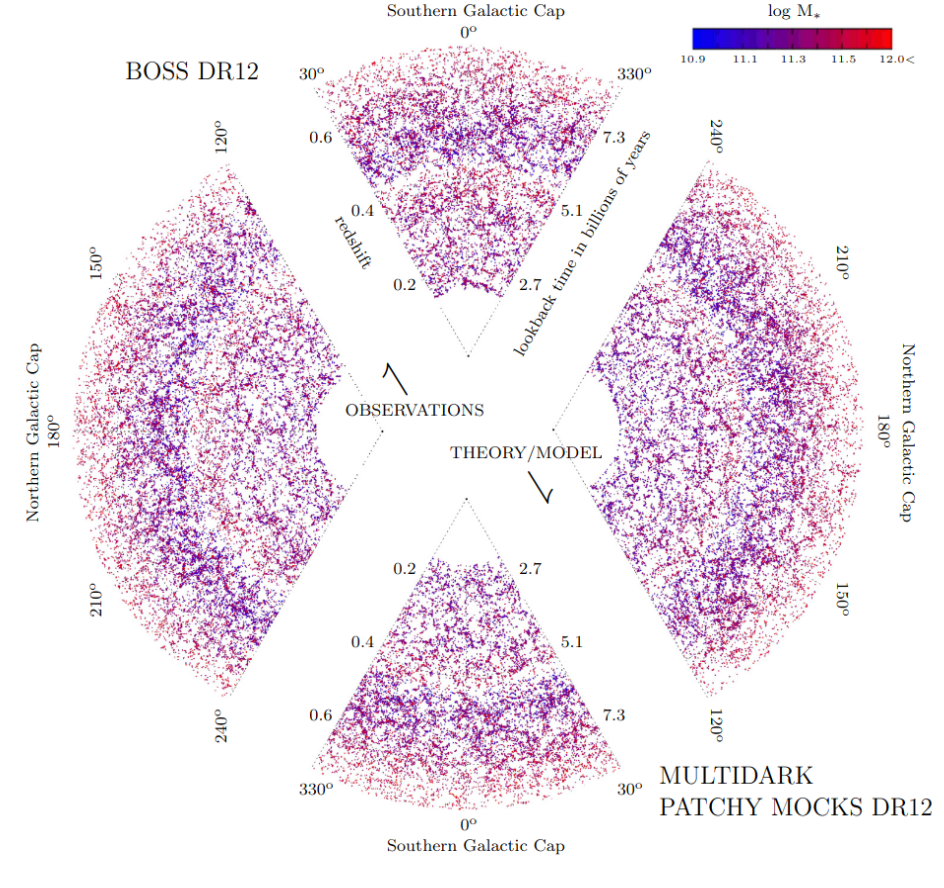
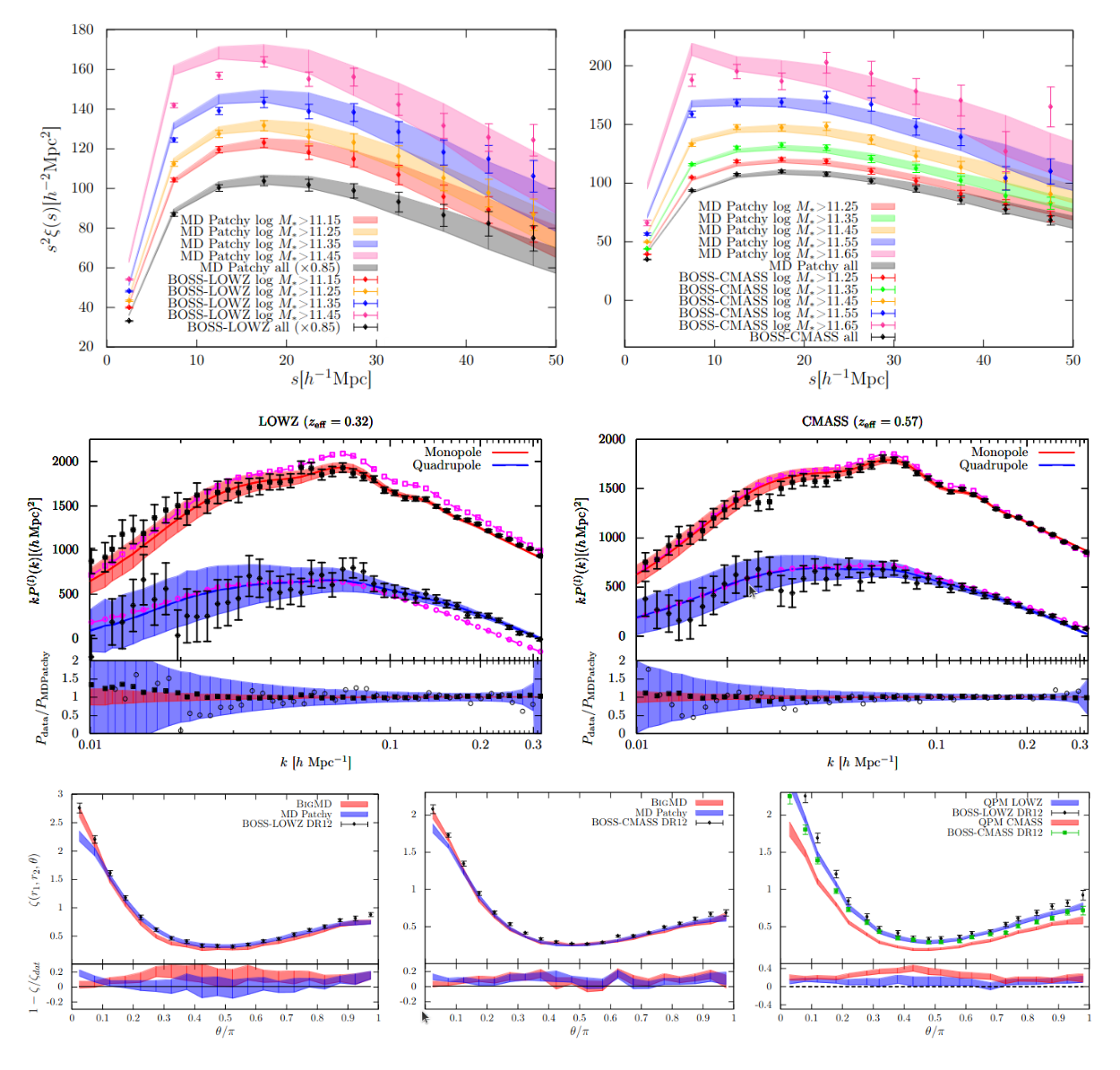
Figure below: Kitaura et al. 2016. Quantitative statistical study of the quality of the mock catalogs. LOWZ denotes the catalog in the range 0.18 < z < 0.43, and CMASS in 0.43 < z < 0.7. The top panels show the correlation function for different stellar-mass bins, demonstrating an unprecedented fit to the observations. The middle panels show the monopole and quadrupole for PATCHY (red and blue lines with their 1-sigma confidence regions) compared with the data (black points with error bars) and the mock catalogs from the Harvard–NYU–Berkeley QPM team, based on a fast N-body code (magenta squares). It is clear that only the PATCHY catalogs reproduce the observations over the range used in the cosmological analysis, up to k ~ 0.3 h/Mpc. The bottom panels show the three-point correlation function in configuration space for side lengths r1 = 10 Mpc/h and r2 = 20 Mpc/h as a function of the angle they subtend. The left and middle bottom panels compare the observations (black points) with an expensive N-body simulation based on BigMultiDark (red) and PATCHY (blue). The bottom-right panel shows the comparison between the observations and QPM. We see that PATCHY even outperforms the BigMultiDark modeling. QPM provides a reasonable model in LOWZ, where it performs poorly for the monopole and quadrupole, and deviates strongly in CMASS, where it does not do as badly for the monopole and quadrupole. These results and analyses were unprecedented and were the reason why the PATCHY catalogs were used in so many studies.