Effective Gravity Solvers
Understanding the large-scale structure of the Universe requires models that are both fast and physically well motivated. Full N-body simulations provide the most accurate description of gravitational evolution, but they are too computationally expensive when very large numbers of realizations are needed, for example to generate mock catalogues for galaxies, quasars, or the Lyman-α\alpha forest. In this context, approximate gravity solvers become essential. A particularly successful family of methods is based on Lagrangian perturbation theory (LPT), which predicts how matter elements move from their initial positions into the cosmic web observed today.
The basic physical picture is simple. On large scales, gravity acts in a smooth and coherent way, and perturbative methods perform very well. On smaller scales, however, matter collapses into filaments, knots, and halos, and simple perturbative descriptions become too diffuse or break down because of shell crossing. The progression from ALPT to eALPT to RLPT can be understood as a sequence of improvements designed to preserve the large-scale accuracy of perturbation theory while producing a more realistic description of nonlinear structure.
1. ALPT ( Kitaura & Heß 2013 ): combining the best of two approximations
Augmented Lagrangian Perturbation Theory (ALPT) starts from a simple but powerful idea: use second-order LPT (2LPT) where it performs best, on large scales, and use the spherical collapse approximation where 2LPT becomes inaccurate, on small scales. The displacement field is therefore split into a long-range and a short-range component, which are then combined through a Gaussian smoothing scale.
This combination is physically well motivated. 2LPT captures large-scale tidal effects very well, but it tends to fail on small scales because of shell crossing. The spherical-collapse term provides a nonlinear correction in the strongly compressive regime, improving the description of both overdense and underdense regions. In practice, ALPT yields a significantly better match to N-body simulations than 2LPT alone, while remaining extremely fast.
In simple terms, ALPT keeps the elegance of perturbation theory on large scales, while correcting its main shortcomings on small scales. It is therefore very well suited for the rapid generation of approximate matter fields and mock catalogues.
2. eALPT ( Kitaura et al. 2024 ): from a one-step approximation to an evolving solver
eALPT can be viewed as the next step in this development. Instead of applying the approximation in a single jump from the initial conditions to the target redshift, eALPT evolves the matter field through a small number of intermediate steps in an Eulerian framework. This already brings the method significantly closer to the behaviour of more expensive numerical simulations.
An important conceptual advance of eALPT is that it allows one to describe effects associated with the stress tensor and to naturally generate vorticity, which are absent in the simplest curl-free LPT picture. This is relevant because the real cosmic web is not simply a smooth compression of matter: as structure forms, more complex flows emerge.
The result is a much more accurate solver than single-step approximations, while still being far cheaper than a full N-body simulation. In this sense, eALPT turns ALPT into a lightweight evolution scheme, following structure formation through several controlled updates and producing a more realistic cosmic web.
Its main limitation is practical: it requires several evolution steps for each target redshift, and its performance degrades at coarse resolutions, typically worse than about 2.5 Mpc/h.
3. RLPT ( Kitaura & Sinigaglia 2026 ): a post-processing correction for coarse resolutions
Ridged Lagrangian Perturbation Theory (RLPT) combines ideas from both ALPT and eALPT, while addressing some of their practical limitations. Like ALPT, it introduces a short-range correction to improve the nonlinear structure. Like eALPT, it does so in Eulerian space. This allows RLPT to apply a correction directly at the target redshift, as a post-processing step on top of an existing LPT calculation. RLPT also introduces an explicit vorticity source.
This is particularly useful because it avoids the need to perform a full multi-step evolution for each output redshift. At the same time, the method is designed to control mode coupling, so that it remains effective even at very coarse resolutions. In other words, RLPT provides a way to sharpen and improve the nonlinear structure of LPT-based models after the main calculation has already been performed.
This makes RLPT especially attractive for applications where computational efficiency is crucial, such as the generation of large ensembles of mocks or field-level forward modelling over very large cosmic volumes.
Summary
These three methods form a natural progression:
- ALPT combines large-scale perturbation theory with small-scale spherical collapse.
- eALPT upgrades this idea into a multi-step evolution scheme with significantly improved accuracy.
- RLPT introduces a flexible Eulerian post-processing correction that works efficiently even at coarse resolution.
Together, they provide a family of fast gravity solvers designed to model the cosmic web with increasing realism while preserving the computational efficiency required by modern cosmology.
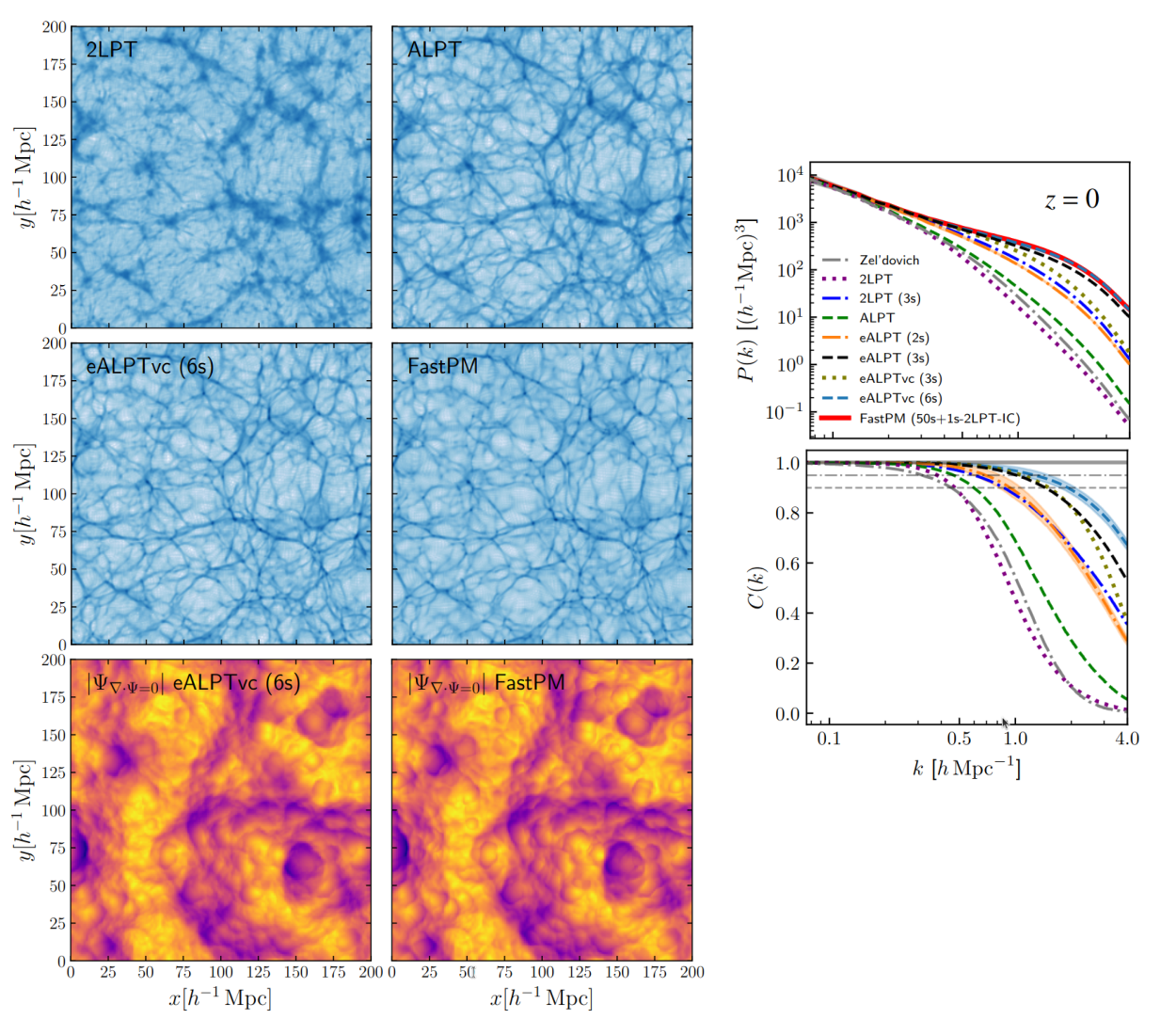
The Figure below shows: Left panels: cosmic density and components of the displacement field obtained with different methods. Top panels: log-density slices at z = 0. Bottom panels: solenoidal component of the displacement field. Right panels: power spectra and cross-correlation spectra at z = 0 for different approximate gravitational solvers, compared with fast N-body simulations (FastPM). The correlations and accuracies achieved for various numbers of steps are shown. The progress achieved with ALPT (Kitaura & Hess 2013) and with eALPT in as few as three steps (3s) can be seen (Kitaura et al. 2024).
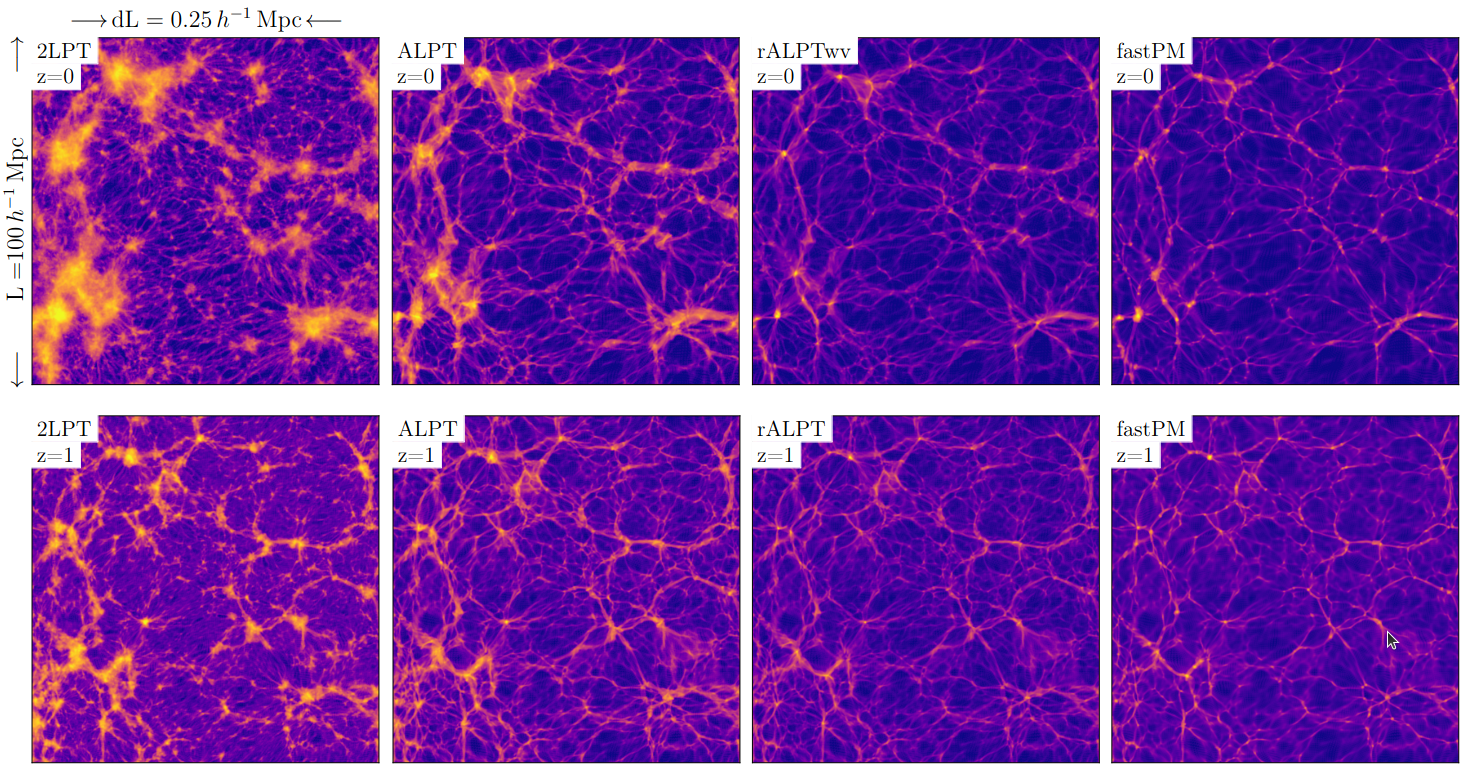
The Figure below: Matter overdensity field. Upper panels: z = 0; lower panels: z = 1. From left to right: 2LPT; ALPT; ALPT with ridging applied (a two-step gravity solver; the upper panel includes the vorticity model); and the FastPM solution (50 time steps, with force resolution equal to the mesh resolution). The simulation box has a side length of 100 Mpc/h and contains (400^3) particles, corresponding to a cell size of 0.25 Mpc/h.