Subgrid modelling below the mesh resolution
Even when the large-scale density field is modelled accurately, a coarse mesh cannot determine the exact phase-space distribution of tracers inside each cell. This becomes important whenever one wants realistic mock catalogues, because galaxies, halos, or quasars are not only defined by their number counts on the grid, but also by their positions and velocities below the mesh scale. Over the years, this has motivated a sequence of increasingly refined subgrid models that reconstruct unresolved phase-space structure from approximate gravity solvers.
1. Particle assignment inside the cell
A first practical approach is to convert the predicted number counts in each mesh cell into discrete tracers by using the phase-space coordinates of dark matter particles from the approximate simulation. When there are enough dark matter particles in a cell, they can be directly used as tracer positions ( Kitaura et al. 2015 ; Kitaura et al. 2016 ). When the required number of tracers exceeds the available particles, additional objects are generated randomly within the cell. This strategy was developed in the PATCHY framework and works particularly well for sparse samples such as BOSS LRG-like galaxies, where the low number density makes this approximation sufficiently accurate for many large-scale applications.
The motivation is simple: using dark matter particles preserves some information on unresolved structure, whereas placing all tracers randomly at the cell center or uniformly within the cell would erase subgrid clustering. At the same time, the original PATCHY papers already noted the limitation of this approach: on sub-Mpc scales, random assignment misses the distinction between central and satellite galaxies, so close-pair structure is not described realistically enough for applications such as fibre-collision studies.
Summary: The first generation of subgrid models used approximate dark matter particles as anchors for tracer positions, and filled missing objects by random intra-cell sampling. This is simple, fast, and effective for sparse populations such as BOSS LRGs.
2. Central–satellite collapse and velocity correction
The next step was to go beyond random intra-cell placement and explicitly mimic the internal structure of collapsed objects ( Balaguera-Antolínez, Kitaura et al. 2023 ). In BAM-based halo and galaxy catalogues, random tracers are first moved toward nearby dark matter particles, introducing a collapse inside the cell that restores small-scale clustering lost by pure random placement. The method defines an effective separation shrinkage: a random tracer is displaced toward its nearest dark matter particle by a fraction of their original distance.
The same work also introduced a velocity correction motivated by the fact that approximate and low-resolution gravity solvers tend to underpredict high peculiar velocities. The coherent velocity field is therefore enhanced with a nonlinear density-dependent rescaling, effectively boosting velocities in denser regions where nonlinear motions are stronger. In addition, for the subgrid tracers, the velocity direction can be rotated toward the collapse axis connecting the random tracer and the nearby dark matter particle, improving the redshift-space signal on small scales.
This idea becomes especially natural once galaxies are split into centrals and satellites. Centrals trace the core of the host halo, while satellites are distributed around them and receive an additional random virial component. In the BAM+HOD implementation, satellites are placed around centrals following an NFW-like profile, and their velocities are built from the halo bulk motion plus an internal random component.
Summary: A more realistic subgrid picture is obtained by identifying central objects and surrounding satellites. Tracers are no longer placed purely at random inside the cell, but are collapsed toward physically motivated anchors, while their peculiar velocities are corrected to compensate for the missing small-scale power of approximate gravity solvers.
3. Collapse toward attractors
A further refinement is provided by CosmoMIA, which formulates subgrid modelling as a multiscale infall problem ( Forero-Sánchez, Kitaura et al. 2024 ). Here, coarse-grid number counts are again converted into tracers using dark matter particles whenever possible, and random particles only when needed. But instead of simply collapsing random tracers toward the nearest dark matter particle, the method identifies special particles called attractors. These are particles judged to be more reliable focal points of collapse because they are real simulation particles and do not lie in void-like environments.
The collapse is then performed in two stages. First, attractors collapse toward other attractors. Second, the remaining particles collapse toward the attractor population, choosing either the nearest central or the one in the densest local environment. In this way, the method tries to reconstruct the tendency of gravity to focus matter toward peaks and ridges of the dark matter field, rather than only toward arbitrary points inside the cell.
CosmoMIA also improves the velocity field. Since approximate solvers often miss coherent small-scale velocity power, the method first boosts the coherent velocity field with an isotropic Fourier-space kernel that preserves large scales while injecting additional power at smaller scales. After that, a stochastic dispersive component is added to satellite particles to account for virial motions.
Summary: CosmoMIA replaces purely local intra-cell assignment by a physically motivated collapse toward attractors, that is, particles identified as likely focal points of gravitational infall. This produces a more realistic subgrid phase-space structure and improves both real-space and redshift-space clustering.
4. Short-range displacement corrections
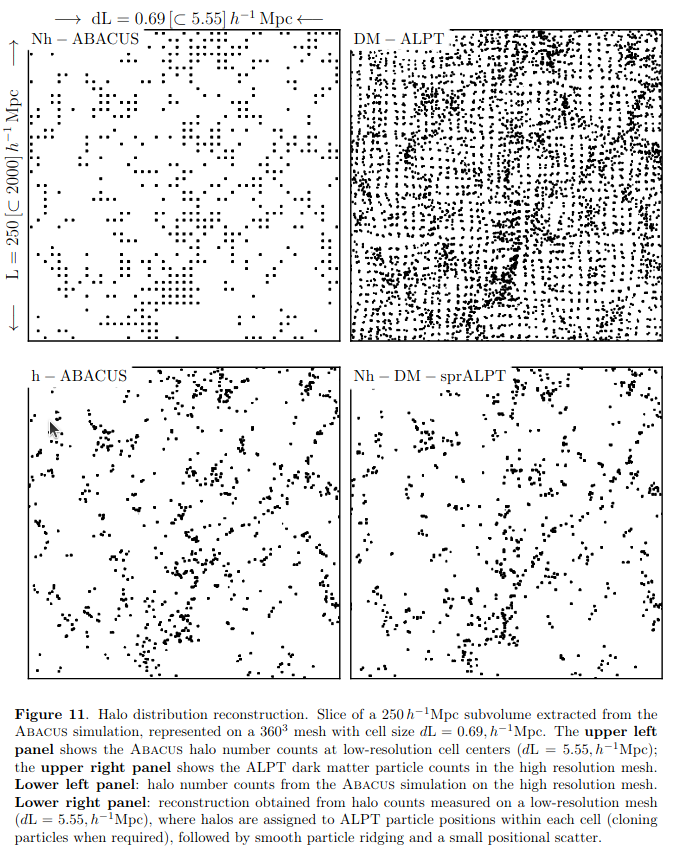
The most recent step is to treat subgrid modelling not only as particle relocation, but as a short-range displacement correction added to the coarse gravity solution itself ( Kitaura & Sinigaglia 2026 ). In RLPT, the large-scale displacement is first generated with LPT or ALPT, and then a second Eulerian “ridging” step reconstructs a short-range, curl-free displacement from the realised density field. The purpose is to sharpen filaments and knots, improve nonlinear morphology, and restore small-scale clustering while preserving the large-scale solution.
An important feature of RLPT is that this ridging step can also be repurposed as a deterministic subgrid relocation model for tracers. Rather than injecting purely random scatter below the mesh scale, one uses the short-range displacement itself to move tracers in a controlled way and tune close-pair clustering beneath a chosen transition scale. This is particularly useful for mock-galaxy production and for observational systematics that depend on small separations.
From the available paper metadata and abstract, RLPT includes two realizations of this idea. One is based on a filtered-mesh short-range completion, where the unresolved response is reconstructed from the density field through scale separation and Poisson inversion. The other is an SPH-inspired smooth-particle ridging scheme, where the short-range correction is built from local particle-based gradients, in analogy with smooth-particle methods. Both are designed to add missing small-scale contraction in a transparent and computationally cheap way.
Summary: The latest generation of subgrid models uses short-range displacement corrections rather than purely stochastic repositioning. In RLPT, a post-processing “ridging” step reconstructs the missing small-scale response from the realised density field, either on a filtered mesh or with an SPH-inspired particle-gradient approach. This sharpens nonlinear structures and allows controlled tuning of tracer clustering below the nominal mesh resolution.
The figure below is extracted from Kitaura & Sinigaglia 2026.