Effective Field Level Bias
Effective field-level bias models describe how observable tracers such as galaxies, quasars, or the Ly- forest emerge from the underlying matter field on the coarse scales relevant for cosmological inference. On these scales, bias is not purely local or linear: it includes nonlinear contributions, nonlocal dependence on the cosmic-web environment, and stochastic deviations from simple Poisson shot noise.
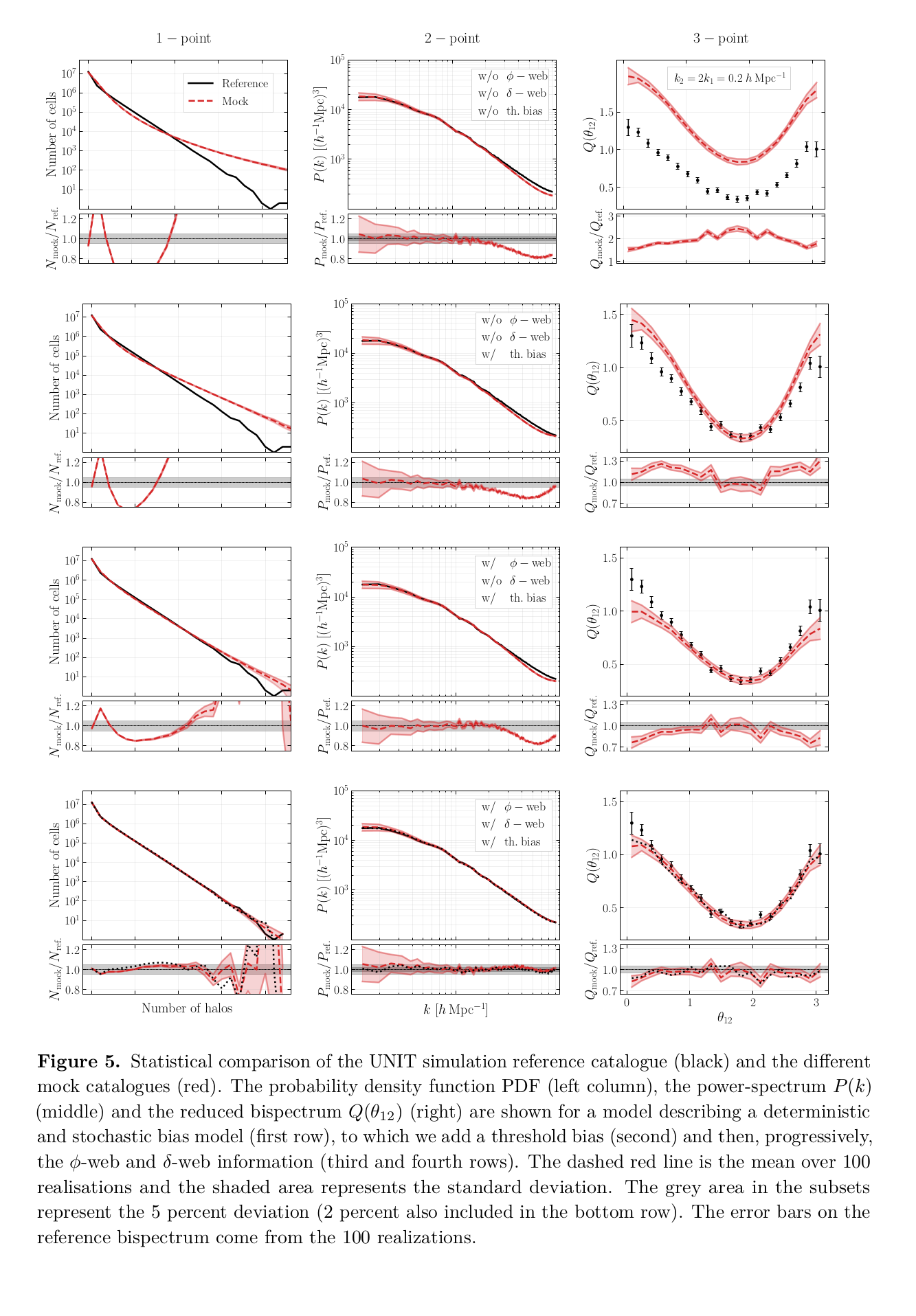
Perturbation theory shows that large-scale bias already requires terms up to third order ( McDonald & Roy 2009 ), but fixed-order expansions can become unstable in the nonlinear regime. Our approach therefore combines physically motivated positive local-bias models with a hierarchical cosmic-web description of nonlocality. Building on the nonlinear bias expansion ( Fry & Gaxtañaga 1993 ; Cen & Ostriker 1993 ) together with threshold-bias picture of Kaiser (1984) and Bardeen, Bond, Kaiser & Szalay (1986) , the hybrid power-law plus low-density threshold (through a step-function) model introduced by Kitaura et al. (2014) and later extended by Neyrinck et al. (2014) with a softer exponential threshold, provides an effective description of nonlinear tracer formation. Deviations from Poissonity --predicted by Peebles (1980) and with models introduced by Saslaw & Hamilton (1984) and Sheth (1995) -- are modelled with the negative binomial distribution, as first proposed in the same field-level context by Kitaura et al. (2014) . We further studied a more general dependence of the deviation from Poissonity in Pellejero, Balaguera, Kitaura et al. (2020) . The mathematical identification of different cosmic-web environments with nonlocal bias enabled us to avoid the problem of truncating a perturbative series Kitaura et al. (2022) . The cosmic web classification was extended to account for different levels into the spectral HICOBIAN model ( Coloma-Nadal, Kitaura et al. 2024 and Kitaura & Sinigaglia 2026 ). In this framework, long- and short-range nonlocal bias are encoded through a hierarchical classification of cosmic-web regions, enabling highly accurate modelling of tracer fields (see Figure below).
Another important ingredient consists of having a non-perturbative parametrized nonlinear description of local bias in each cosmic web region. This is achieved through an extension of the power-law plus low-density threshold model with a high-density threshold model which accounts for halo-exclusion for galaxy distributions ( Coloma-Nadal, Kitaura et al. 2024 ) or flux absorption saturation for Lyman alpha forests ( Sinigaglia, Kitaura et al. 2024 and Sinigaglia, Kitaura, Nagamine et al. 2024 ).
The Figure below is extracted from Coloma-Nadal, Kitaura et al. 2024.
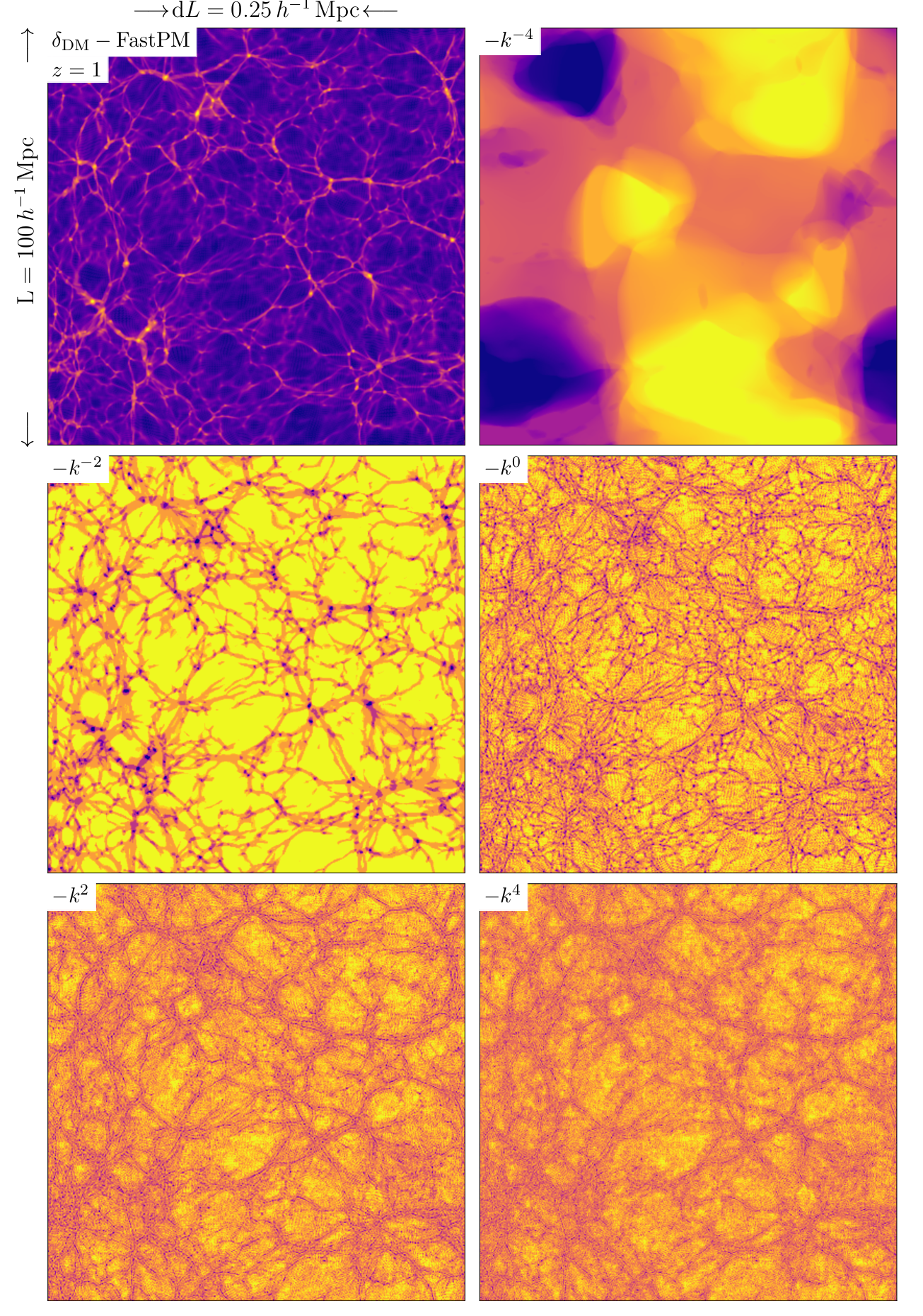
The Figure below: Top left: FastPM at z = 1 assigned to a mesh. The side length is 100 h^−1 Mpc and the
cell size is dL ≃ 0.25 h^−1 Mpc. Other panels show the cosmic web classification contrast corresponding
to the kernel hierarchy: (top right) −k^−4 , (middle left) −k^−2 , (middle right) −k^0 , (bottom left)
−k^2 , (bottom right) −k^4.