Note on the new EMIR detector.
F. Garzón, October 2024
Since the end of summer 2023, EMIR has a new detector, the H2RG type, much more sensitive and stable than the previous one. However, it is not free from certain undesirable artifacts that need to be corrected in post-processing.
The first thing to note is that the detector has a pronounced lack of linearity at high count regimes. We are working to mitigate this effect, but for now, the user must handle it themselves if he believes it affects the quality of the data. If ramp mode is selected, it will suffice to fit a polynomial of a certain degree and retain the linear part. Canipe et al. (2017) suggest fitting a fifth-degree polynomial.
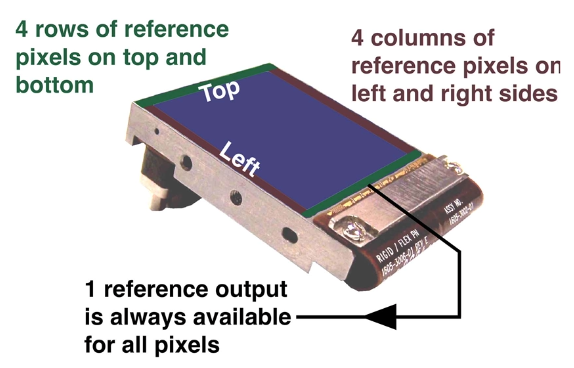
The detector has a sensitive area of 2040x2040 pixels and is surrounded by a 4-pixel-wide strip that is not illuminated and can be used as a reference to subtract the BIAS variation during integration. We plan to integrate this processing, in its basic form, into the EMIR control system, but for now, the user must handle this processing.
For this latter process, a Python script ( corr_ref_pxs_simple3.py) is offered to handle the task. Its operation is simple and is described below. First, remember that the detector is read through 32 independent channels oriented vertically:
- Place the data to be processed in a specific directory, including the full set, both raw and preprocessed.
- Select a directory for writing the processed data.
- The basic processing, by default, takes the median of each 4-pixel section of each channel, both above and below, averages them, and subtracts the result from the entire channel. This process is done on each of the individual frames that make up the complete exposure.
- Some additional options can be selected, whose effect must be evaluated by the user, as the result depends heavily on the data to be processed:
- Perform a low-degree polynomial fit on the vertical reference sections, on the right and left of the detector, and use this to normalize the horizontal reference signals before subtracting.
- Include a differentiated treatment for even or odd columns (ACN; Rauscher et al. 2017).
- Eliminate the last reset frame, which is used by default in data preprocessing in the control system, to calculate the final signal. This will reduce the effective integration time by the read time of one frame (~1.45s).
This script is still in beta version and may be modified based on the results obtained from successive detector calibrations. Therefore, feedback on any problems observed is requested.